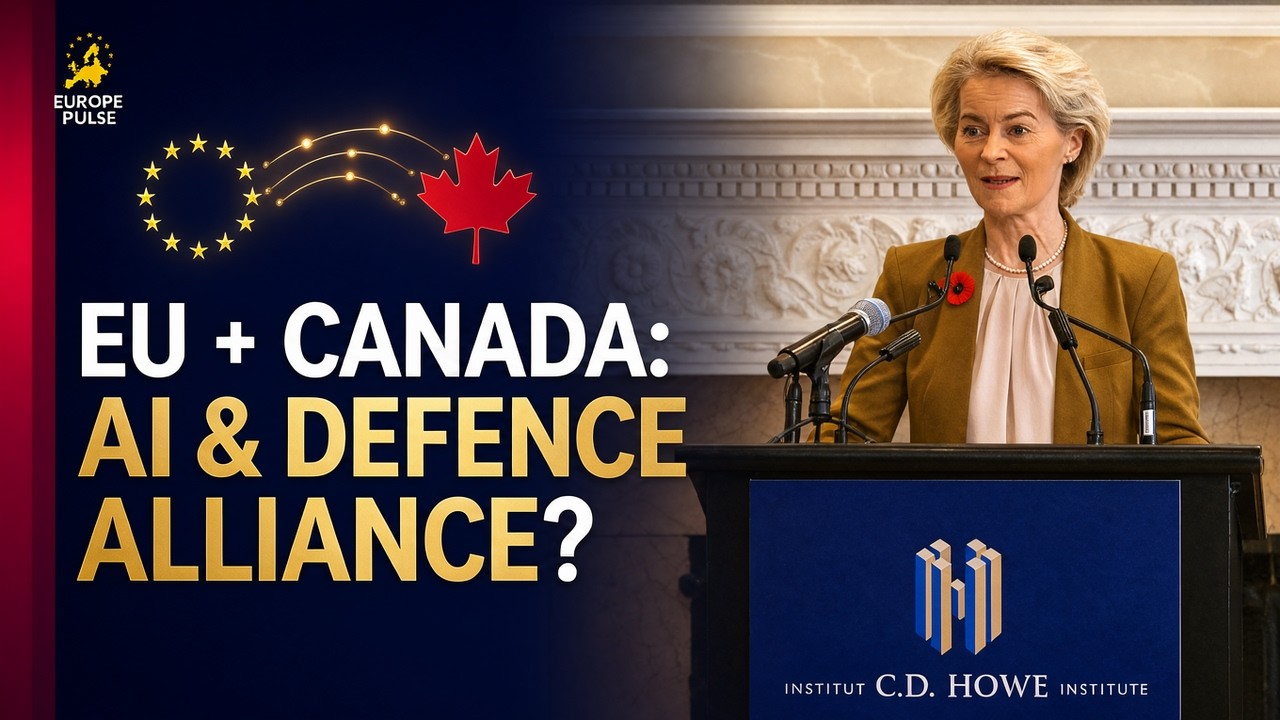
European Commission President Ursula von der Leyen has outlined a comprehensive vision for a significantly deepened partnership between the European Union and Canada, proposing a new model of association that could bring the North American nation closer to the EU than any previous non-member relationship. Speaking at the C.D. Howe Institute event in Montreal during the EU-Canada summit on October 29-30, 2026, von der Leyen presented an “Alliance for the Future” spanning economic security, critical minerals, artificial intelligence, and defence.
The core of von der Leyen’s proposal is an “association without accession,” a relationship designed to be closer to EU membership than existing partnerships, yet explicitly excluding full membership for Canada. She highlighted potential alignment on policies, governance, and programmes, envisioning closer collaboration between the European Commission and Canada’s government, alongside possible cooperation between parliaments and courts. This ambition, she noted, is rooted in a shared history, referencing figures like Jean Monnet’s experience in Canada and Canada’s pivotal role in liberating the Netherlands during World War II, as well as a closing reference to Montreal poet Leonard Cohen’s themes of resilience and solidarity.
Forging a Closer EU-Canada Partnership
Von der Leyen argued that the evolving landscape of international alliances and rivalries necessitates trusted partners acting together. Her proposed Alliance for the Future aims to create a common space for prosperity, resilience, and economic security. She underscored the risks of dependence on single suppliers, which can lead to economic pressure impacting household costs and industrial stability. In this context, Canada would bring vital resources and mining expertise, while Europe would offer industrial demand, technology, and investment.
The proposal includes deeper engagement in educational and research initiatives. Canada is discussed as a possible first EU associate member, which could lead to stronger participation in the next generation of Horizon Europe, cooperation on skills and qualifications to facilitate professional mobility across the Atlantic, and deeper engagement in Erasmus programmes.
Strengthening Strategic Supply Chains and Critical Minerals
A key pillar of the proposed alliance focuses on strategic supply chains, particularly critical minerals. Von der Leyen proposed a common space supported by joint or complementary investment, private finance, and a project pipeline involving investment, export, and infrastructure banks. This cooperation would encompass the entire value chain, from extraction and processing to advanced materials and recycling.
She cited significant growth in EU imports of Canadian critical raw materials, which reportedly rose 62% in value last year, reaching €3.3 billion (C$5.18 billion). Lithium, cobalt, nickel, and graphite were specifically named as essential inputs for electric vehicles, clean energy, and future industries. This emphasis on critical minerals aims to reduce dependencies and enhance economic security for both partners.
Bilateral trade has also seen substantial growth, with von der Leyen crediting the Comprehensive Economic and Trade Agreement (CETA) for an increase of more than 80%. She highlighted new Canadian contracts for a French manufacturer and an Ontario business doubling its exports to Europe. The Commission’s summit context indicated that 2025 goods-and-services trade reached €130 billion, approximately 80% above 2016 levels.
Cooperation in AI, Supercomputing, and Defence
The proposed partnership extends into cutting-edge technologies like Artificial Intelligence and supercomputing. Von der Leyen outlined plans for joint rules, standards, safety work, infrastructure investment, and research. She mentioned an announced Aleph Alpha-Cohere merger and anticipated an agreement to integrate Canada into Europe’s supercomputing infrastructure, which comprises a network of 12 supercomputers. This would allow Canadian industry, startups, and researchers to utilise this infrastructure, including for training AI models. She also warned that dependence on a few large AI companies could expose businesses and essential services to decisions taken elsewhere, reinforcing the need for collaborative development.
Defence and security also feature prominently. Canada’s leadership of a NATO brigade in Latvia was highlighted, and von der Leyen noted Canada as the first non-European participant in SAFE, the EU’s joint defence procurement instrument. Strong support for Ukraine was underscored, acknowledging the more than a million Canadians with Ukrainian roots, refuge provided to hundreds of thousands of Ukrainians since 2022, and joint efforts to return Ukrainian children kidnapped by Russia.
Arctic security is another area for potential collaboration. With retreating ice creating new routes and Russia’s military presence reshaping the region, von der Leyen stressed the importance of cooperation. She noted that three EU member states are Arctic countries, with over half a million EU citizens residing there. Joint projects in ocean monitoring, critical minerals, and connectivity for remote communities, supported by Copernicus satellite imagery, are envisaged.
A Vision for Shared Action
In her speech, Ursula von der Leyen articulated a clear ambition: “we can build a partnership that comes closer to membership than anything we’ve done before.” She emphasised that the essence of this proposed alliance “is the capacity to act together” and that “we put human agency first.” These proposals, including the associate membership and Canadian supercomputing access, remain under discussion and are not yet implemented, reflecting the forward-looking nature of the summit discussions.
What is the proposed EU-Canada associate membership?
European Commission President Ursula von der Leyen has proposed a new form of association for Canada, designed to be closer to EU membership than existing partnerships but without granting full accession. This would involve deeper alignment on policies, governance, and programmes.
What areas would the EU-Canada partnership cover?
The proposed “Alliance for the Future” would span economic security, critical minerals, trade, artificial intelligence, supercomputing, and defence. It aims to create a common space for prosperity, resilience, and economic security between the two entities.
What is the significance of critical minerals in this proposal?
Critical minerals are a key focus, with proposals for joint investment and cooperation across the supply chain from extraction to recycling. This aims to secure essential inputs like lithium, cobalt, nickel, and graphite for clean energy and future industries, reducing reliance on single suppliers.