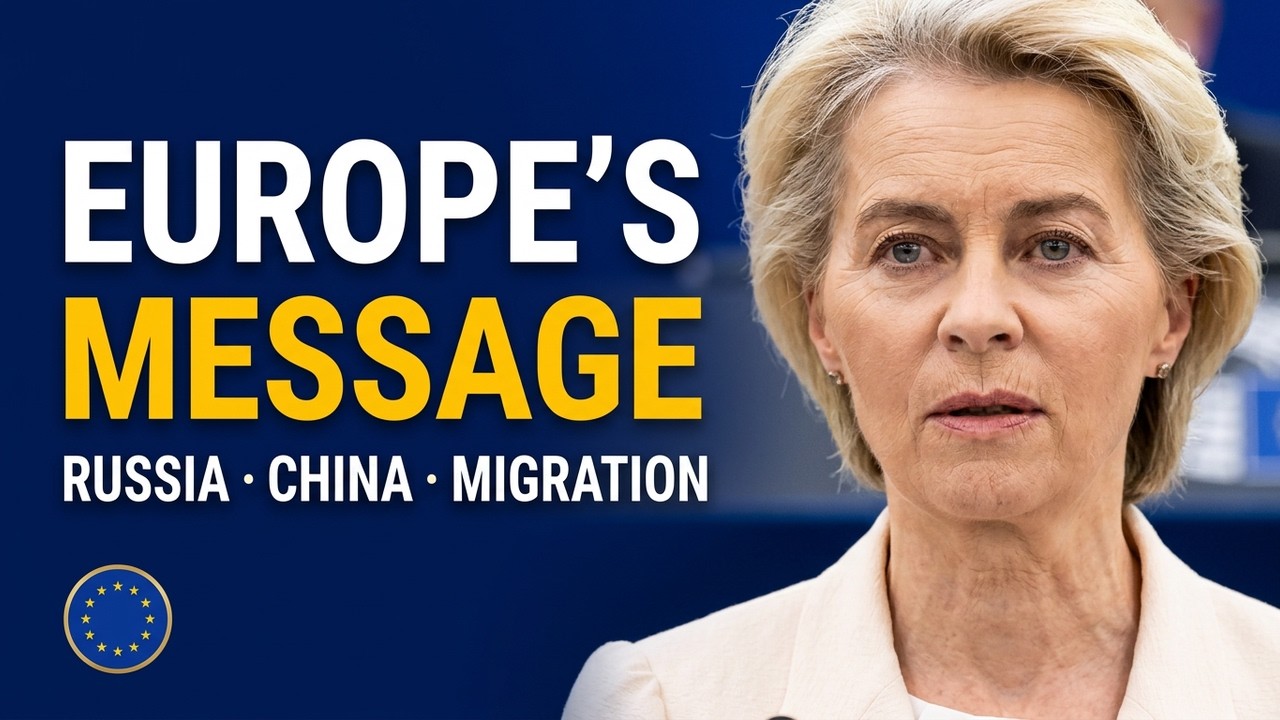
European Commission President Ursula von der Leyen has outlined the EU’s strategic priorities, affirming that energy sanctions against Russia will remain in place until the war in Ukraine ceases. Addressing the European Parliament in Strasbourg following the European Council meeting, von der Leyen also detailed proposals for strengthening Europe’s economic security, managing relations with China, and reforming migration policy.
EU Competitiveness and Economic Security
Von der Leyen emphasized that Europe’s competitiveness hinges on a stronger single market, administrative simplification, and reduced energy costs. She highlighted proposed simplification measures that could save businesses over €22 billion annually in administrative burdens, suggesting the use of AI to enable single data reporting.
The Commission plans to develop a comprehensive European Energy Union strategy, encompassing grids, interconnectors, and joint purchasing power. On energy dependence, von der Leyen stated, "there should be no critical dependence on one single supplier." This aligns with the ongoing commitment to maintain sanctions on Russia, with her clear message: "these sanctions will stay until Russia stops the war."
Navigating China Relations and Trade
Addressing the EU’s trade relationship with China, von der Leyen noted the EU’s 2025 trade deficit with China at approximately €1 billion per day. She announced that China has agreed to cut tariffs on EU products valued at nearly €4 billion. Furthermore, an annual quota of 350,000 hybrid vehicles from China has been agreed, aiming for an export reduction of around 45%, with a safeguard mechanism still to be implemented.
To bolster economic resilience, a "Diversify EU" package is planned for December, alongside proposed tools for economic deterrence and European solidarity. This strategy aims to combine negotiations with trade defense and diversify supply chains.
Migration and Border Control
Regarding migration, von der Leyen presented figures indicating a decrease in illegal border crossings by 56% over two years and 34% so far this year, with asylum applications down 19% and a return rate above 30%. She called for consistent implementation of common rules, stronger support from Frontex, and a new framework for extraordinary threats at Europe’s external borders, proposing a European emergency response framework by the end of 2026.
Parliamentary Debate Highlights
During the opening debate, Milan Uhrík of the Europe of Sovereign Nations Group, Slovakia, accused von der Leyen and Ukrainian President Zelensky of seeking another €70 billion from Europeans. In contrast, Manfred Weber of the European People’s Party Group, Germany, called for a unified "European perspective," linking migration challenges in Syria and a drone shield in the east to shared European interests, stating, "so let’s do this from a European perspective."
FAQ: EU Policy Priorities
-
What is the EU’s stance on Russia sanctions?
Ursula von der Leyen confirmed that energy sanctions on Russia will remain until Russia ceases its war against Ukraine.
-
What measures are proposed to boost EU competitiveness?
Proposed measures include administrative simplification, potentially saving over €22 billion annually, and the development of a European Energy Union plan covering grids, interconnectors, and joint purchasing.
-
How is the EU addressing trade imbalances with China?
China has agreed to cut tariffs on EU products worth nearly €4 billion, and an annual quota of 350,000 hybrid vehicles from China has been agreed upon, aiming for a 45% export reduction, with a safeguard mechanism to follow.