
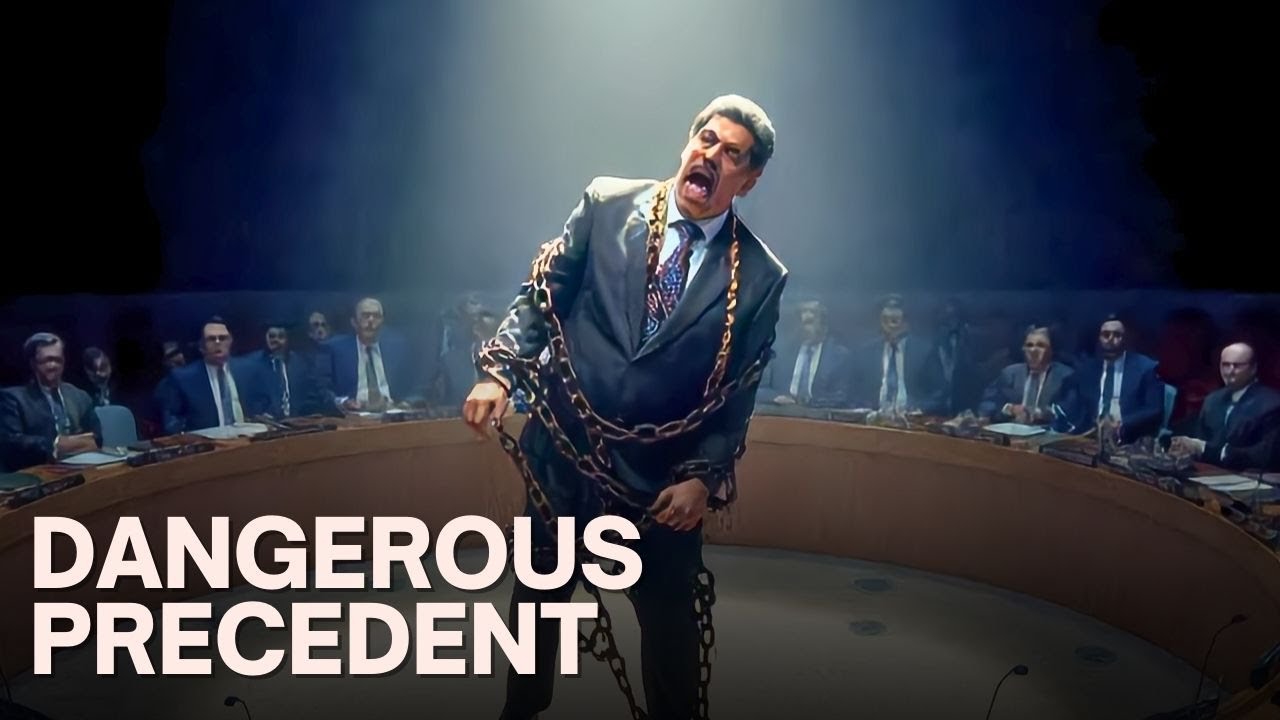
Emergency session exposes deep rift over international law, sovereignty, and power
The United Nations Security Council convened an emergency session following a dramatic escalation between the United States and Venezuela, after Washington announced it had carried out a law enforcement operation resulting in the detention of Venezuelan President Nicolás Maduro.
The move — described by the United States as the arrest of a long-indicted narcotics trafficker — was condemned by Venezuela and several Council members as a violation of sovereignty, a breach of head-of-state immunity, and a dangerous precedent for the international system.
What the United States Says It Did
Addressing the Council, US Ambassador Michael Waltz rejected claims of military aggression, insisting the operation was strictly legal in nature.
According to the US, President Maduro and First Lady Cilia Flores were indicted fugitives under American law, accused of narco-terrorism and drug trafficking. Washington argued that enforcing these indictments did not constitute war, occupation, or regime change.
“This was a surgical law enforcement operation,” Waltz told the Council, stressing that the United States was acting under the rule of law rather than using force against the Venezuelan people.
The US delegation also framed the operation within a broader regional security context, warning against Venezuela becoming a base of operations for hostile state and non-state actors, including Iran-linked groups and organized crime networks.
Venezuela’s Response: “Kidnapping a Head of State”
Venezuela’s Ambassador to the UN, Samuel Moncada, categorically rejected the US account, accusing Washington of abducting a sitting president in violation of one of the most fundamental norms of international law.
Moncada argued that head-of-state immunity is not a personal privilege, but an institutional safeguard designed to protect state sovereignty and international stability.
“Its disregard sets an extremely dangerous precedent for all states, regardless of their size, power, or alliances,” he warned.
Venezuela formally demanded:
-
the immediate release of President Maduro and the First Lady
-
a clear condemnation of the use of force
-
reaffirmation of the principle that territory and resources cannot be acquired by force
-
de-escalation measures to protect civilians and restore international law
Russia, Colombia, and Regional Alarm
Russia strongly backed Venezuela’s position. Ambassador Vassily Nebenzia described the US operation as armed aggression, accusing Washington of acting with “unparalleled cynicism” and calling for the immediate release of Venezuela’s leadership.
Colombia, which requested the emergency meeting alongside China and Russia, focused on regional consequences. Colombian Ambassador Leonor Zalabata Torres warned that the action threatened Latin America’s long-standing commitment to resolving disputes peacefully and risked destabilizing a region formally recognized as a zone of peace.
The UN’s Institutional Warning
The most carefully worded intervention came from the UN Secretariat. Rosemary DiCarlo, speaking on behalf of Secretary-General António Guterres, avoided assigning blame but delivered a clear reminder of first principles.
She emphasized:
-
respect for the UN Charter
-
respect for sovereignty and territorial integrity
-
the prohibition of the threat or use of force
Crucially, DiCarlo noted that international law already provides mechanisms to address narcotics trafficking, disputes over resources, and human rights concerns — without resorting to unilateral force.
Economist Jeffrey Sachs reinforced that message, arguing that the Council’s role was not to judge Maduro personally, but to defend the UN Charter itself.
Resources, Power, and the Core Dispute
One of the most revealing moments came when US representatives pointed directly to Venezuela’s vast energy reserves, among the largest in the world. Venezuela countered that its oil, energy, and strategic position have historically made it a target of external pressure.
Moncada warned that using force to control resources or impose political outcomes echoes the worst practices of colonialism and neo-colonialism.
At its core, the confrontation exposed a fundamental divide:
-
Can a powerful state enforce its domestic law beyond its borders?
-
Or does doing so undermine the legal order it claims to defend?
Why This Matters Beyond Venezuela
The case has implications far beyond Caracas or Washington.
If unilateral arrests of sitting heads of state become normalized, critics argue, the protections of sovereignty and diplomatic immunity could erode globally, particularly for smaller or weaker states.
That concern — more than the fate of one leader — explains why the Security Council session resonated so strongly, and why it may shape future debates over the balance between power and law in international relations.
