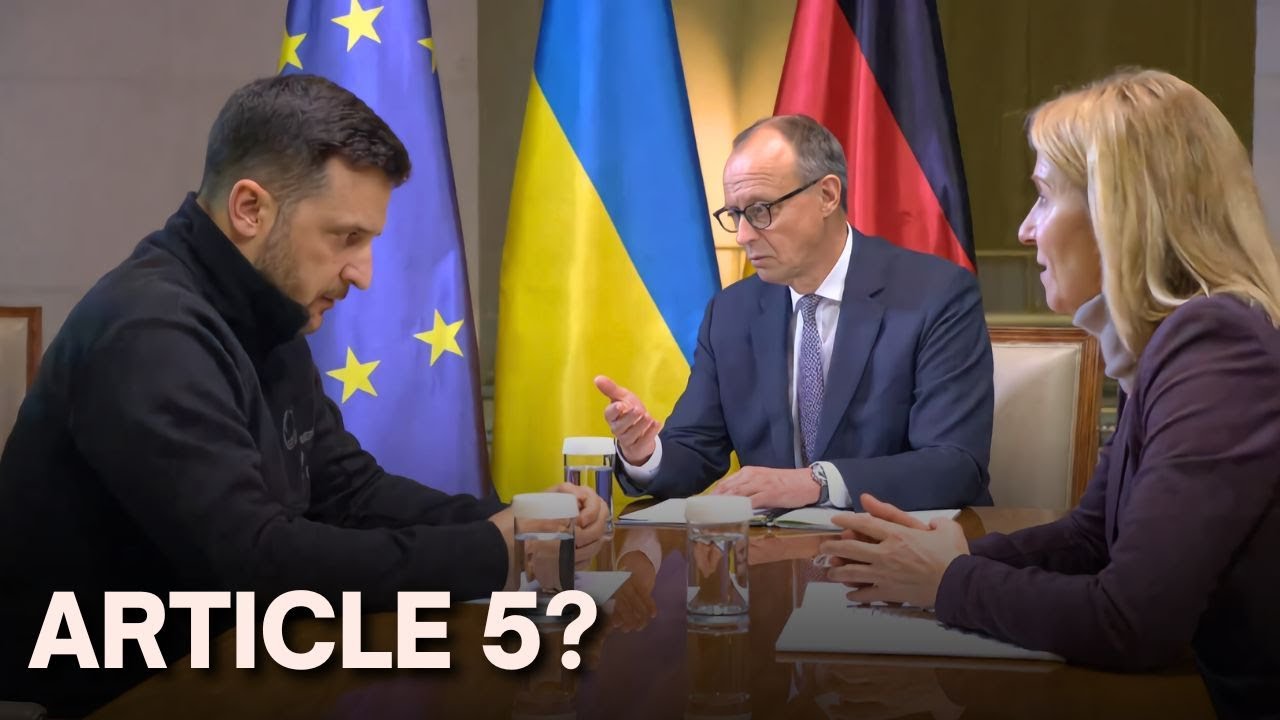
High-level negotiations in Berlin and Brussels have opened what European leaders describe as the most serious diplomatic window for ending Russia’s war against Ukraine since February 2022.
Statements by Ukrainian President Volodymyr Zelensky, German Chancellor Friedrich Merz, and EU foreign policy chief Kaja Kallas reveal both progress — and the hard limits of any potential peace deal.
At the heart of the talks: security guarantees comparable to NATO’s Article 5, territorial demands from Moscow, and Europe’s readiness to back Ukraine not just politically, but materially.
Berlin Talks: Why This Moment Matters
Speaking after closed-door negotiations in Berlin, Chancellor Friedrich Merz said Europe is experiencing an unprecedented diplomatic push.
He confirmed that Ukrainian, European, and U.S. negotiators have been working intensively on a ceasefire framework, with American envoys playing a central role. According to Merz, the talks are difficult, confidential, and deliberately structured to avoid the failures of past agreements.
“We will not repeat the mistakes of Minsk,” Merz said, referring to earlier ceasefire deals that collapsed due to weak enforcement.
Merz also warned that Russia is deliberately playing for time, maintaining maximalist demands while continuing attacks against Ukrainian cities and civilian infrastructure.
Article 5-Like Security Guarantees: A Major Shift
The most significant development concerns security guarantees for Ukraine.
According to a senior U.S. official cited by Reuters, the backbone of a future agreement would be “very strong guarantees, like Article 5” — the NATO clause that treats an attack on one ally as an attack on all.
Merz publicly welcomed what he described as substantial legal and material commitments now being discussed by the United States and European partners.
Zelensky made clear why this matters. With NATO membership effectively off the table for now, Ukraine insists that any ceasefire must be backed by credible deterrence, not political promises.
Security guarantees, he stressed, must include:
-
Clear enforcement mechanisms
-
Monitoring of ceasefire violations
-
Defined consequences for Russia if the agreement is broken
Without these elements, Ukraine fears a repeat of past freezes that allowed Moscow to regroup and strike again.
Territory: The Hardest and Most Sensitive Issue
Territorial questions remain the most explosive part of the negotiations.
Russia is reportedly demanding that Ukraine withdraw even from parts of Donbas that Russian forces do not fully control. Kyiv has repeatedly rejected such demands.
Zelensky acknowledged that territorial discussions are painful but unavoidable.
“The question of territories is painful,” he said, while emphasizing that only Ukraine can decide on its land.
This position was explicitly supported by both Merz and Kaja Kallas.
Kallas warned against any false moral equivalence between aggressor and victim.
“Concessions should be made by the aggressor, not the victim,” she said.
She also cautioned that Donbas would not be Russia’s final objective if rewarded with territorial gains.
Europe’s Leverage: Sanctions, Money, and Frozen Assets
Beyond diplomacy, Europe is increasingly focused on economic leverage.
The EU is providing €27 billion in military support to Ukraine this year alone, while also stepping up sanctions against Russia’s shadow fleet and hybrid operations.
A key issue is the use of frozen Russian assets.
Merz confirmed that the EU has now established a legal basis to keep these assets immobilized long-term — a necessary step toward using them for Ukraine’s defense and reconstruction.
Zelensky openly welcomed this approach, calling it both a practical security measure and a political signal to Moscow that aggression carries lasting costs.
Kaja Kallas described the reparations mechanism as a potential game changer, arguing that Russia must be held financially accountable for the destruction it has caused.
Is a Ceasefire by Christmas Possible?
Merz stated that joint Ukrainian-European-American proposals have now been prepared and will be presented to Russia.
According to U.S. officials, roughly 90 percent of disputed issues have been addressed, with negotiations continuing at working level in the United States and potentially in Russia.
Still, European leaders were clear:
The outcome now depends on Moscow.
Merz directly appealed to the Russian leadership to halt attacks on civilians at least over the Christmas period, calling recent strikes on energy infrastructure, hospitals, and kindergartens acts of terror against the population.
What This Means for Ukraine and Europe
These talks do not yet amount to peace.
But they do mark a strategic shift.
For the first time, Western leaders are openly discussing robust security guarantees, not temporary ceasefires. At the same time, Ukraine’s territorial sovereignty and European future are being framed as non-negotiable principles.
As Kaja Kallas put it, letting Ukraine fall would cost Europe far more than supporting it now.
Whether this diplomatic opening becomes a lasting peace — or another missed opportunity — depends on whether Russia is willing to accept deterrence instead of domination.