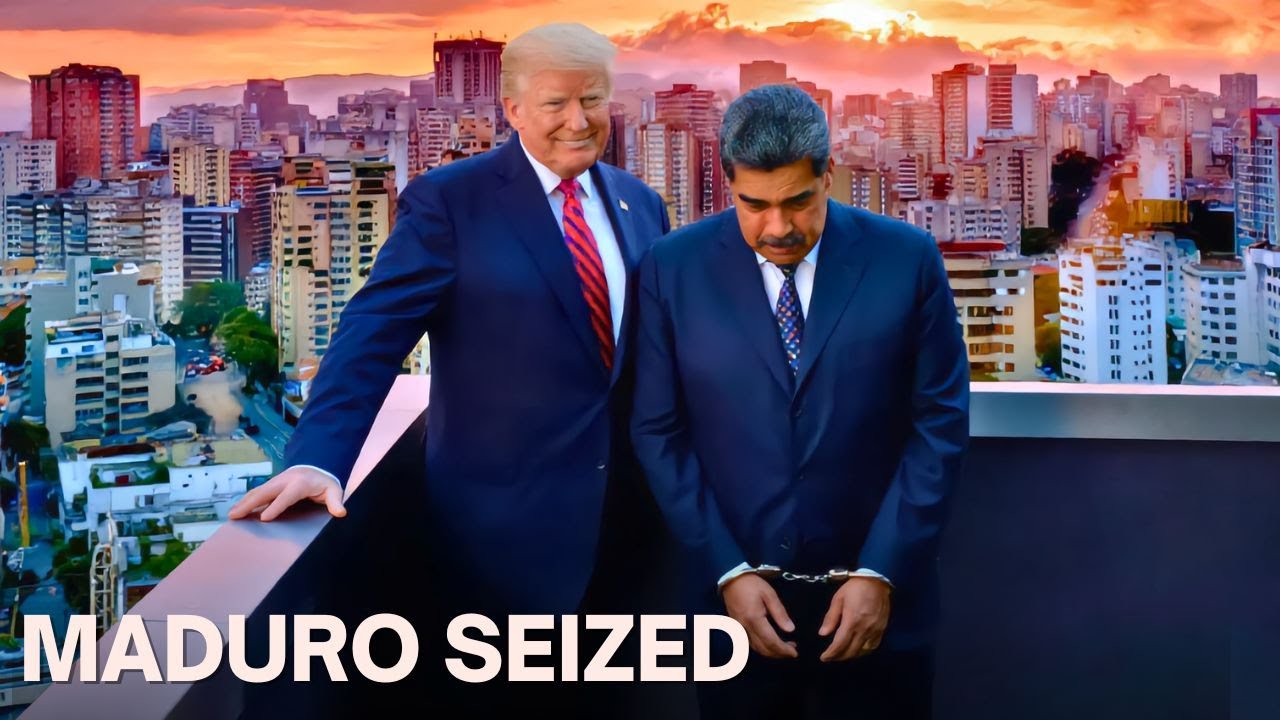
The United States has launched confirmed military strikes inside Venezuela, triggering one of the most dramatic escalations in US–Venezuela relations in decades. US President Donald Trump announced that Venezuelan President Nicolás Maduro and his wife, Cilia Flores, were detained and airlifted out of the country during the operation.
Trump made the announcement on his Truth Social platform, stating that the United States had carried out a “large-scale attack” targeting the Venezuelan leadership. He said the operation was conducted in accordance with US law and promised further details during an emergency press conference at his Mar-a-Lago residence in Florida.
Venezuela’s government responded by saying it does not know where Maduro is and demanded proof from Washington that both he and his wife are alive. Vice President Delcy Rodríguez addressed the nation on state television, accusing the United States of violating Venezuelan sovereignty and calling the situation an unprecedented act of aggression.
According to reporting by CBS News, elite US Delta Force units were involved in detaining Maduro. The deployment was later confirmed by US Deputy Secretary of State Christopher Landau, who said the Venezuelan president would be held accountable for alleged crimes. Delta Force previously carried out the 2019 operation that killed Islamic State leader Abu Bakr al-Baghdadi in Syria.
Overnight, multiple explosions were reported in Caracas and surrounding states, including Miranda, Aragua, and La Guaira. Witnesses described at least seven explosions within a thirty-minute period, accompanied by the sound of low-flying aircraft. Parts of the Venezuelan capital lost electricity, particularly near major military installations, and smoke was seen rising from a military hangar.
Venezuelan Defence Minister Vladimir Padrino condemned the US action, claiming American strikes hit both military and civilian areas. He announced the full mobilization of Venezuela’s ground, air, naval, riverine, and ballistic defense systems, warning that the country would resist the presence of foreign troops on its territory.
Earlier, Maduro had declared a state of emergency, describing the situation as one of “external aggression.” The decree significantly expands the powers of the armed forces and allows further restrictions on civil liberties. The government urged citizens to mobilize and defend the country, accusing Washington of seeking regime change.
The crisis has also reached the international stage. Caracas has formally requested an emergency meeting of the United Nations Security Council to address what it calls a US military assault. The United States, meanwhile, maintains that its actions are part of a broader fight against international drug trafficking networks.
Trump has repeatedly accused Maduro and members of his family of links to powerful drug cartels, allegations the Venezuelan leader has consistently denied. Washington argues it is engaged in an armed conflict with narco-trafficking organizations it designates as foreign terrorist groups. Colombian President Gustavo Petro recently stated that US forces bombed a suspected cocaine production facility near the Venezuelan port city of Maracaibo.
Venezuela’s political opposition has so far remained cautious in its response. However, opposition leader and Nobel Peace Prize laureate María Corina Machado previously expressed support for increased international pressure on Maduro, saying stronger measures were needed to force political change.
As conflicting claims continue to emerge, the situation on the ground remains volatile. The alleged detention of Maduro, combined with active military operations and nationwide mobilization, marks a turning point in the long-running standoff between Washington and Caracas, with potentially far-reaching consequences for regional stability and global diplomacy.