
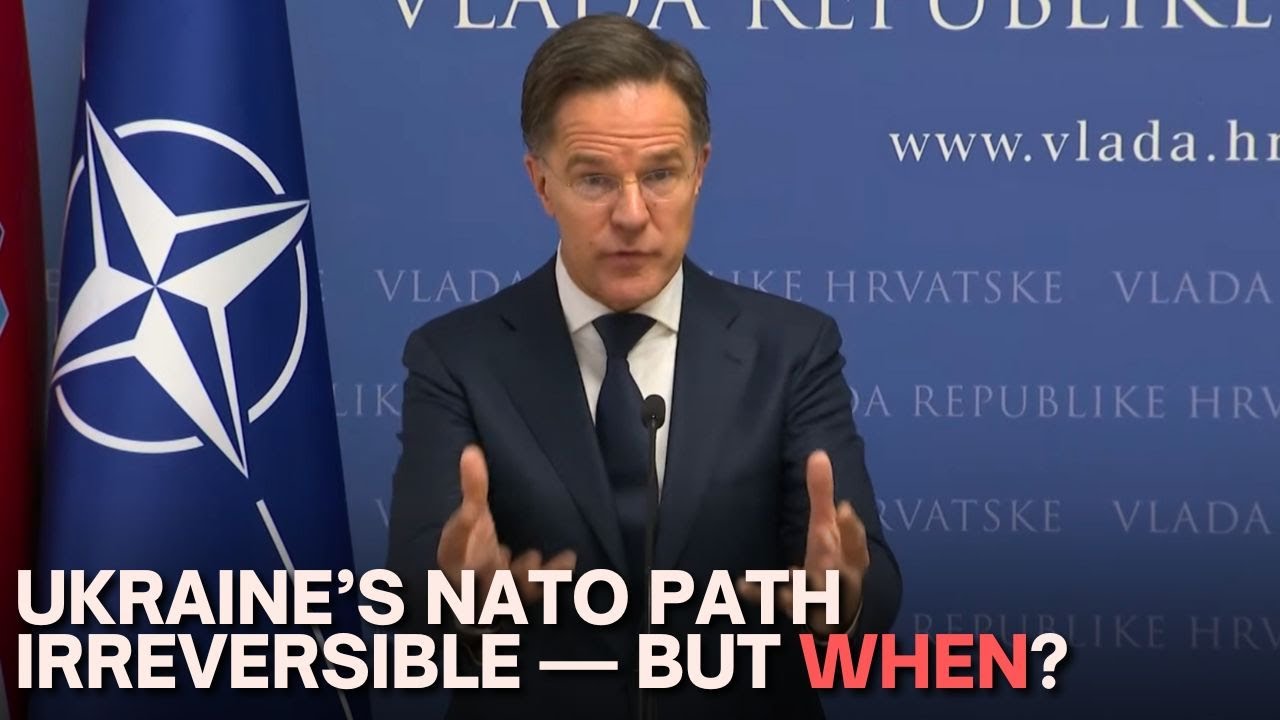
NATO Reaffirms Ukraine’s “Irreversible Path” as Allies Debate Security Guarantees After the War
NATO Secretary General Mark Rutte has reaffirmed that Ukraine’s path toward NATO membership remains politically irreversible, while acknowledging that divisions among allies continue to block full accession in the near term. Speaking at a joint press conference in Croatia with Prime Minister Andrej Plenković, Rutte referenced the 2024 Washington NATO Summit, which formally committed the Alliance to Ukraine’s eventual membership.
Rutte stressed that the commitment still stands, despite opposition or skepticism from several NATO members, including Hungary and the United States. He said the immediate priority remains managing the war triggered by Russia’s “brutal and unprovoked” invasion of Ukraine in February 2022 and preparing long-term security arrangements once fighting stops.
The NATO chief outlined ongoing discussions within the so-called “coalition of the willing,” led by France and the United Kingdom, aimed at preventing future Russian aggression after a peace agreement or long-term ceasefire. These talks focus on a three-layer security model designed to protect Ukraine even without immediate NATO membership.
According to Rutte, the first layer would be Ukraine’s own armed forces, strengthened to deter future attacks. The second layer would involve an organized coalition of willing nations providing collective support and protection alongside Ukrainian forces. The third layer includes sustained involvement by the United States in various security and coordination roles.
Rutte credited U.S. diplomatic engagement for breaking the stalemate with Moscow, saying President Donald Trump initiated dialogue with Russian President Vladimir Putin when others could not. He highlighted the roles of U.S. envoys and senior officials, noting that recent meetings in Paris helped define security guarantees and reconstruction planning.
Territorial questions, Rutte said, remain the most sensitive issue. He emphasized that decisions on occupied territories must ultimately be taken by Ukraine’s democratically elected government, with full backing from its military and international partners. He warned against repeating the failures of the post-2014 Minsk agreements, which did not prevent renewed Russian aggression.
Prime Minister Plenković echoed these concerns, stating that Russia remains the aggressor and must agree to peace terms for any settlement to hold. Drawing on Croatia’s own war experience, he argued that Ukraine should never be pressured to surrender occupied territory, calling such concessions a dangerous reward for aggression.
Plenković said Russia’s broader objectives include restoring relations with the United States, lifting international sanctions, and rehabilitating its global standing, with Ukraine used as leverage in that process. He confirmed that Croatia will not deploy troops on Ukrainian territory but will continue providing political, energy, and military assistance.
The Croatian government has already approved the donation of unused energy infrastructure to Ukraine to help restore power systems damaged by Russian strikes, particularly during winter conditions. Plenković said Croatia would also continue bilateral military aid, stressing that only a strong Ukrainian army can prevent future invasions.
Both leaders acknowledged that NATO membership requires unanimous consent, which does not currently exist. Until that consensus is reached, they said alternative security guarantees—potentially resembling NATO’s Article 5 protections—remain essential to safeguarding Ukraine’s future.
——————————————————
*Subscribe to Europe Pulse*
Stay updated with the latest news from Europe
