
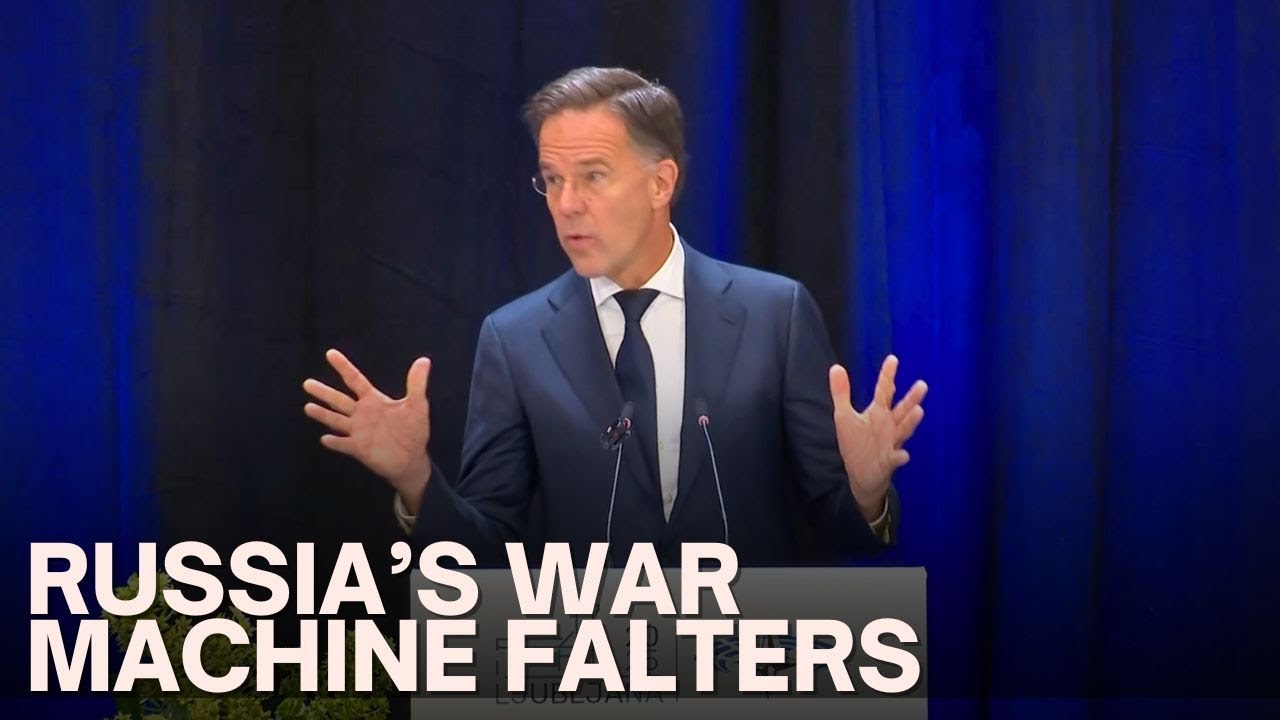
NATO Chief Mark Rutte Calls for Unity and Higher Defense Spending Amid Rising Global Threats
#NATO #MarkRutte #NATOSummit
Speaking in Ljubljana on 13 October 2025, NATO Secretary General Mark Rutte addressed the NATO Parliamentary Assembly, calling for renewed unity, higher defense investment, and stronger resilience against global security threats. Rutte opened by welcoming the ceasefire between Israel and Hamas, announced following President Donald Trump’s visit to Israel, calling it “a good day for peace and stability.” He expressed hope that such progress could soon be mirrored in Europe, where “a lot of work” remains to secure the continent.
Rutte paid tribute to Lord Campbell, a long-serving NATO parliamentarian known for his dedication to the transatlantic alliance, before turning to the strategic challenges facing NATO. He warned that Russia, China, North Korea, and Iran are working together to “reshape the global order,” noting that Russia now dedicates 40% of its national budget to its war economy and plans to produce 1,500 tanks, 3,000 armored vehicles, and hundreds of Iskander missiles this year alone.
He emphasized that NATO is responding decisively, with allies committing to invest up to 5% of GDP in defense and related security investments — a landmark increase aimed at matching U.S. spending levels. European allies and Canada, Rutte said, are “on a trajectory to equalize” with the United States.
At the NATO Summit in The Hague, member states agreed to expand defense production, ensuring their militaries are equipped to face present and future threats. Rutte reaffirmed NATO’s “enduring support for Ukraine,” highlighting a new program — the Prioritized Ukraine Requirement List (PERL) — which has already transferred $2 billion worth of lethal and non-lethal military aid to Ukraine. He noted that this initiative is “saving lives” and must continue at full pace.
Rutte thanked NATO parliamentarians for mobilizing public and political backing for these efforts, underscoring the immediacy of modern threats. “The new generation of Russian missiles can reach European capitals in minutes,” he said, also citing drone warfare, cyberattacks, and undersea sabotage as growing dangers.
He praised NATO’s rapid response to Russian drone incursions into Polish airspace, noting the Eastern Sentry operation launched within 36 hours to reinforce NATO’s eastern flank. Defense ministers, he added, will meet this week to strengthen deterrence and finalize investment plans.
Rutte cautioned against both underestimating and overestimating Russia: though its forces are weakened — with over one million Russian soldiers killed or injured and its navy “a shadow of its former self” — Moscow remains “deeply dangerous.” He highlighted ongoing cyber, espionage, and sabotage operations, including parcel bomb attacks across Europe and the discovery of Russian spyware in the UK.
The Secretary General concluded by stressing the need for civil preparedness, cyber defense, and critical infrastructure protection. “The home front and the front line are now one and the same,” he said. His final appeal: for NATO nations to “stand strong together” to protect one billion citizens across the Alliance.
——————————————————
*Subscribe to Europe Pulse*
Stay updated with the latest news from Europe.
#EuropePulse #BreakingNews #EU #WorldNews #Politics #TrendingNow #NewsUpdate #Analysis #Ukraine #Russia #USA #UK #EuropeanUnion #NATO #WorldEvents #CurrentAffairs #EUnews #TopStories #InternationalNews #Brussels #Leaders #ViralNews #Headlines
