
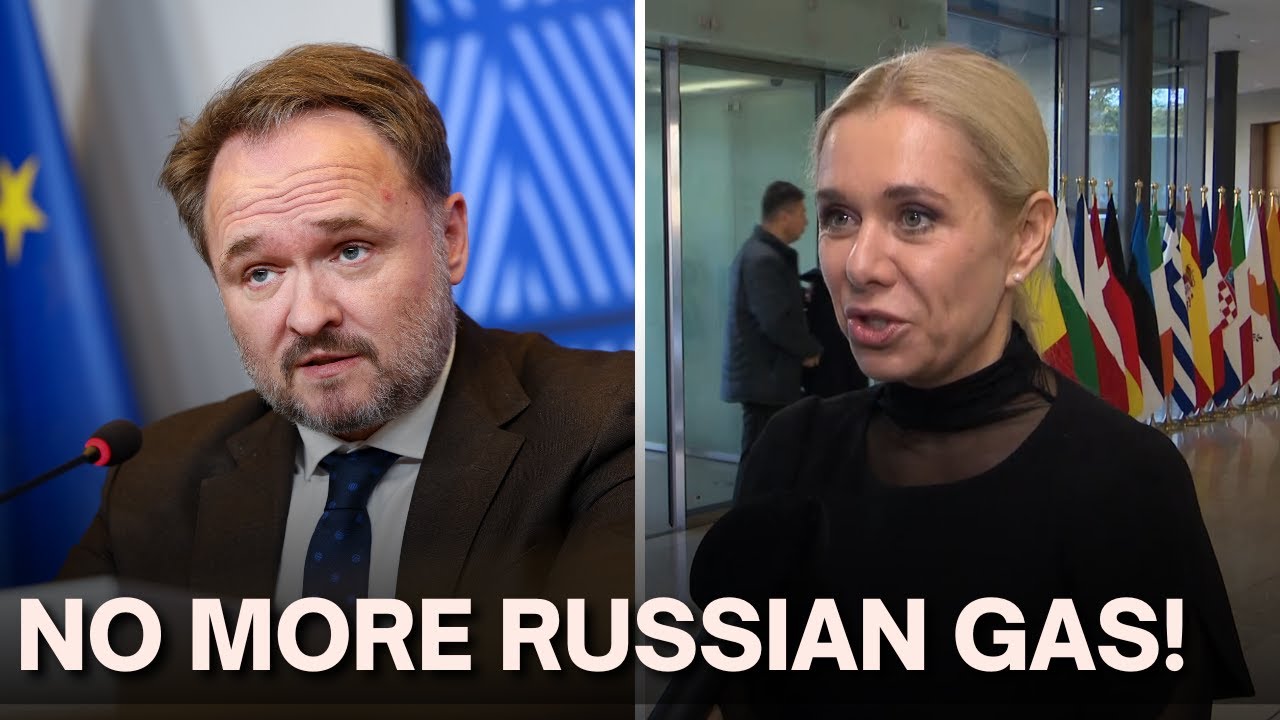
EU Backs Ban on Russian Gas: Full Phase-Out by 2028, Loans Backed by Frozen Assets to Fund Ukraine
#EUEnergy #RussianGasBan #REPowerEU
EU energy ministers in Luxembourg approved landmark rules to end Russian gas imports, setting a legal ban from 1 January 2026 with transitional allowances for existing contracts until 17 June 2026 (short-term) and 1 January 2028 (long-term).
According to the Danish Presidency, only two member states opposed the compromise; the decision passed by qualified majority voting.
Commissioner Dan Jørgensen hailed the move as a “freedom package,” saying Europe will no longer finance Russia’s war machine and will diversify supply.
Danish Energy Minister Lars Aagaard called the deal “historic,” adding that the EU will now push for a final text with the European Parliament before the winter break.
Jørgensen underlined the structural shift since 2022: coal from Russia fell from 50% to 0%, oil from 27% to 3%, and gas from 45% to ~13% of EU imports.
He stressed the ban is a trade prohibition, not a sanctions package, built to outlast any future ceasefire.
Ministers said security-of-supply and price impacts are manageable, with the Commission pledging support measures via its Affordable Energy Action Plan.
The rules cover pipeline gas and LNG, advancing the REPowerEU strategy to cut dependence on a supplier that has “weaponized energy.”
Debate also touched oil and nuclear fuel, with Denmark signaling proposals to end remaining dependencies.
Despite Slovakia and Hungary voicing concerns, the Presidency emphasized solidarity instruments to ease short-term effects.
From Prague, Czech industry minister Lukáš Vlček said Czech infrastructure can reroute western-route gas to support Slovakia “almost immediately” if needed.
Vlček noted Czech steps—TAL pipeline upgrade and storage build-up—as examples of early adaptation.
He backed an earlier LNG ban by 1 January 2027 under the pending 19th EU sanctions package.
EU foreign policy chief Kaja Kallas expects that 19th package to be cleared later this week, though not by the foreign ministers’ meeting itself.
Kallas linked pressure to peace, saying Russia negotiates only when forced, and welcomed U.S. efforts while insisting Ukraine and Europe must be at the table.
Ministers also discussed the Commission’s “reparations loan” mechanism to mobilize up to €185 billion from frozen Russian assets as collateral, without confiscation.
Belgium and Luxembourg have raised financial-stability questions, but backers argue legal design can protect credit ratings.
Finland’s FM Elina Valtonen said the plan would finance Ukraine’s recovery now, with legal recourse to use assets if Russia refuses to pay damages.
Latvia’s FM Baiba Braže urged states to move “from words to deeds” and fund Ukraine’s priority defense list.
The energy deal now heads into trilogues with the European Parliament, with both Council and Commission seeking closure before year-end.
Officials cautioned that the ban is not the end of the transition: Europe must scale domestic, decarbonized electricity, biogas, and biomass, and integrate power markets.
The combined push—energy decoupling, sanctions tightening, and frozen-asset financing—is presented as a single strategy to deny the Kremlin revenue and support Ukraine’s defense and reconstruction.
Jørgensen said the EU will keep prices in check while hardening infrastructure for the coming winter and beyond.
The Presidency’s message to Moscow, Kyiv, and Washington: “Europe will not import Russian gas anymore—and we will help Ukraine win peace on fair terms.”
——————————————————
*Subscribe to Europe Pulse*
Stay updated with the latest news from Europe.
#EuropePulse #BreakingNews #EU #WorldNews #Politics #TrendingNow #NewsUpdate #Analysis #Ukraine #Russia #USA #UK #EuropeanUnion #NATO #WorldEvents #CurrentAffairs #EUnews #TopStories #InternationalNews #Brussels #Leaders #ViralNews #Headlines
