
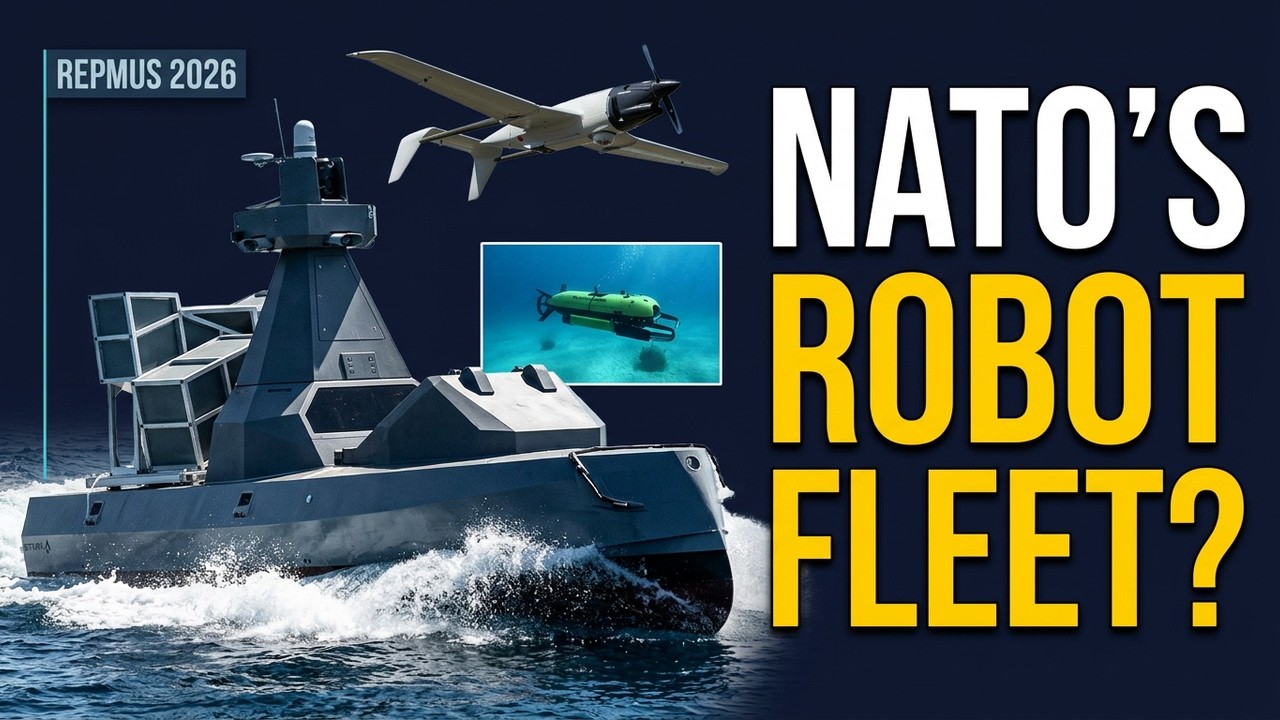
NATO is currently conducting a significant month-long experiment in Portugal, known as REPMUS 2026, to test the integration of artificial intelligence, drone swarms, and robot ships in future maritime warfare. Led by the Portuguese Navy, the exercise aims to advance naval capabilities by exploring how autonomous vessels, underwater vehicles, and aerial drones can communicate, share data, and collaborate to enhance decision-making for operators.
REPMUS 2026: Pioneering Autonomous Naval Systems
The Robotic Experimentation and Prototyping with Maritime Unmanned Systems (REPMUS) experiment is taking place from August 31 to September 25, 2026, along Portugal’s Tróia Peninsula. More than 1,500 personnel, including participants from dozens of navies and technology companies, are contributing military experience, industry expertise, and scientific research to this shared testing environment.
Technologies under evaluation include uncrewed helicopters, fixed-wing drones, drone swarm demonstrations, uncrewed airships, and uncrewed surface vessels. The experiment also features underwater vehicles for mine detection and aerial seabed mapping systems. A Ukrainian team is participating, launching a a catapult drone, highlighting the practical application of these emerging technologies.
Strengthening Maritime Operations Through Interoperability and AI
A central focus of REPMUS 2026 is interoperability, ensuring that diverse uncrewed systems can effectively communicate, exchange information, and operate cohesively. Justin Simmons of NATO’s Defence Innovation Accelerator for the North Atlantic (DIANA) emphasized the role of AI, stating, “AI data decision-making tools that are really reducing the time that it takes for operators to make critical decisions.”
The experiment also explores how these autonomous systems can undertake dangerous tasks, such as minesweeping, and extend the operational reach of existing fleets. Captain Sérgio Ricardo Caldeira de Carvalho, Director of the Portuguese Navy Operational Experimentation Centre (CEOM), underscored the strategic importance, noting, “If you have the technological upper hand, you have the advantage on the battlefield.”
João Alves, Head of Experimentation and Exercise at NATO’s Centre for Maritime Research and Experimentation (CMRE), highlighted the collaborative effort: “There’s great technology being provided by industry and by nations, systems that can do amazing things, but we need to maximise how these things work together.” This collaborative approach, bringing together armed forces, industry, academia, and scientists, is crucial for understanding operational needs and developing solutions to strengthen NATO’s capabilities.
What is REPMUS 2026?
REPMUS stands for Robotic Experimentation and Prototyping with Maritime Unmanned Systems. It is a month-long NATO-led experiment in Portugal testing the integration of AI, drone swarms, and robot ships for future naval warfare.
When and where is REPMUS 2026 taking place?
The experiment is scheduled from August 31 to September 25, 2026, along Portugal’s Tróia Peninsula.
What is the main goal of REPMUS 2026?
The primary goal is to test interoperability, enabling different uncrewed systems to communicate, share data, and operate together, ultimately helping operators make faster decisions and enhancing maritime operations.
