
EU Commission Unveils Defence Package and “Military Schengen” to Speed Troop Movements Across Europe
#defence #schengen #security
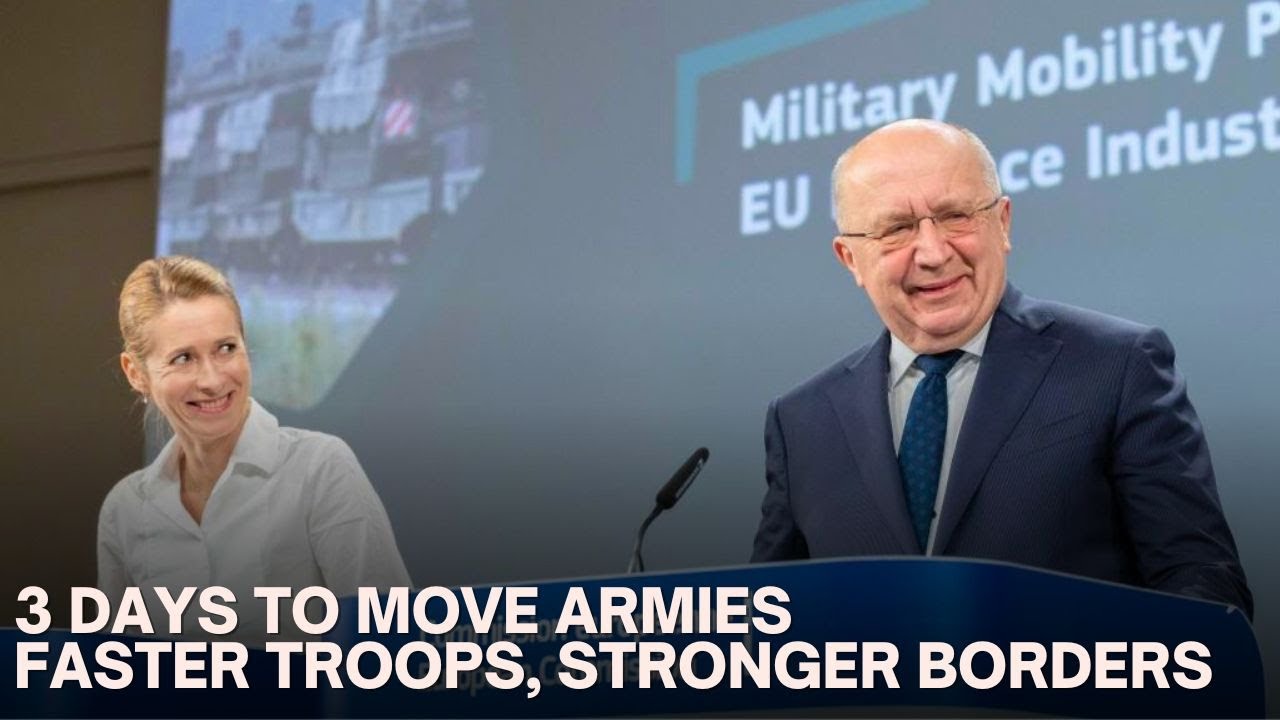
The European Commission has unveiled a sweeping new defence package aimed at transforming Europe’s defence industry and creating a so-called “military Schengen” to move troops and equipment across the EU in days rather than weeks. Executive Vice-President Henna Virkkunen, High Representative Kaja Kallas, Defence Commissioner Andrius Kubilius and Transport Commissioner Apostolos Tzitzikostas presented the package at a press conference in Brussels. The package includes an EU Defence Industry Transformation Roadmap, a joint communication on military mobility, and a draft regulation to harmonise rules for transporting military equipment, goods and personnel across the Union.
Virkkunen said the roadmap complements the previously adopted Defence Readiness Roadmap and focuses on four priorities: supporting investment in defence companies, accelerating new technologies, expanding access to defence capabilities, and building the skills needed to keep Europe’s technological edge. She stressed that disruptive technologies such as artificial intelligence, quantum, cyber and space systems are changing modern warfare, with Ukraine’s battlefield experience showing how quickly defence technologies evolve. The roadmap seeks to better connect deep-tech civilian innovators with defence needs, including through the EU Defence Innovation Office in Kyiv, which will be upgraded into a broader EU defence industry office.
Kubilius underlined that the roadmap is designed to transform both the “supply side” of industry and the “demand side” of military doctrine, learning directly from Ukraine’s experience. He announced plans for a €1 billion defence-focused “fund of funds” with the European Investment Bank to keep European defence start-ups in Europe rather than relying on non-EU capital. He also flagged a new pilot instrument, “AGILE”, inspired by the DARPA model, to deliver low-cost, defence-ready solutions in just six to twelve months with rapid iteration alongside armed forces.
On military mobility, all four Commissioners repeatedly used the term “military Schengen” to describe a future system where European troops and heavy equipment can cross borders fast and safely. Kallas said the goal is to move forces in days, not weeks, and warned that “weakness invites them to make their move,” referring to Russia. She linked the initiative to Monday’s sabotage attack on the Warsaw–Lublin railway line in Poland, which Polish authorities have described as an unprecedented act of sabotage against critical infrastructure, and argued that Russia’s attacks on infrastructure are becoming “increasingly brazen.”
The proposed regulation would introduce the first ever EU-level harmonised rules for military mobility, including a maximum three-day processing time for permits in peacetime and streamlined customs and dangerous-goods procedures. During crises, an emergency framework called the European Military Mobility Enhanced Response System (EMERS) would allow automatic permits and priority access to rail and air capacity, reducing movements to notification rather than full authorisation. Kubilius stressed that, for the first time, 27 different national permit systems would be replaced by a single Union-wide procedure.
The package also introduces a “solidarity pool” of dual-use transport assets – such as rail wagons, flatbed trailers, trucks and heavy airlift – that can be shared voluntarily by Member States or pre-contracted civilian providers and managed by the Commission, drawing on its crisis-management experience. Infrastructure is the second pillar: Tzitzikostas explained that the military mobility concept is built on the EU’s Trans-European Transport Network (TEN-T) and four classified military mobility corridors agreed in March. Together with Member States, NATO and EU military staff, the Commission has identified more than 500 hotspots and bottlenecks along those corridors that require upgrades for dual-use military and civilian traffic.
The Commission estimates that upgrading these hotspots will require around €100 billion in investment by 2030, with funding coming from national budgets, the EU’s cohesion policy funds, the SAFE and Action for Europe programmes, and, in the next long-term budget, a ten-fold increase in the Connecting Europe Facility envelope for military mobility to about €17 billion. Tzitzikostas stressed that projects will be dual-use, meaning that deeper ports, stronger bridges and upgraded rail lines will benefit trade and civilian travel as much as military deployments. He also emphasised the need for a “corridor mindset,” where upgrades on one side of a border are matched by similar work in neighbouring states.
——————————————————
*Subscribe to Europe Pulse*
Stay updated with the latest news from Europe.
