Marta Kos: 2025 EU Enlargement Report Shows Real Progress — but “No Time for Complacency”
00:00 Opening & Report Methodology
01:13 Geopolitical Context & Why Enlargement Matters
03:23 Front-Runners and Timelines: Montenegro, Albania, Moldova, Ukraine
07:10 Setbacks and Critiques: Serbia, Western Balkans, Georgia, Turkey
09:30 The Road Ahead: Reforms, Safeguards, and EU Readiness
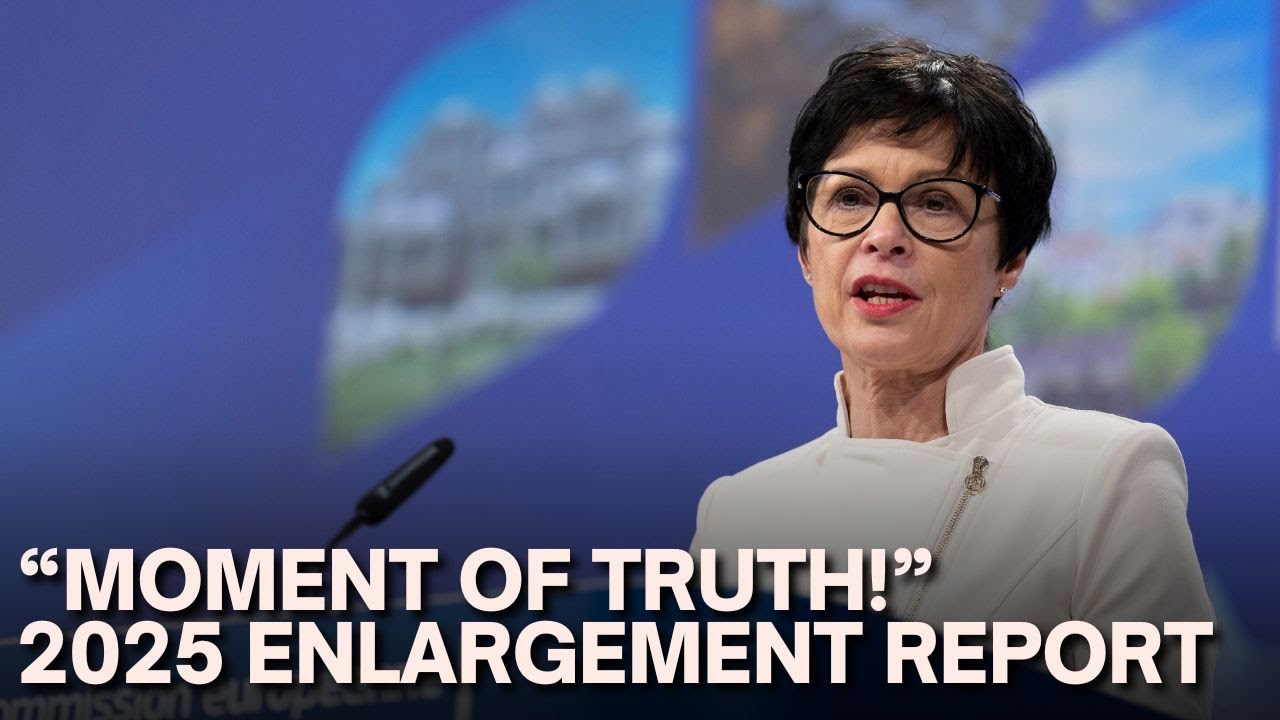
At the European Commission’s Brussels press conference unveiling the 2025 EU Enlargement Package, European Commissioner for Enlargement Marta Kos presented the Commission’s latest assessment of candidate countries — describing the year as “a very good year for enlargement” and confirming that EU expansion in the coming years is a realistic possibility.
Kos thanked her team for what she called “hundreds of hours of work” that went into the 2025 Enlargement Report — a document exceeding 100 pages per country, detailing progress, challenges, and preparedness for accession. She underlined that the report is both an evaluation and an offer of partnership: “We are willing to help — but candidates must deliver too.”
Framing enlargement against the backdrop of a rapidly changing geopolitical landscape, Kos stressed that European security and prosperity depend on completing the unification of the continent, adding: “Only if we complete the unification of Europe can we ensure peace, freedom and prosperity.”
Kos highlighted four frontrunners — Montenegro, Albania, Moldova, and Ukraine — as countries showing the strongest reform momentum and political will. She confirmed their ambitious membership timelines: Montenegro aims to close accession talks by 2026, Albania by 2027, and both Moldova and Ukraine by 2028.
Montenegro remains the most advanced candidate, with four negotiation chapters already closed and five to six more expected by the end of 2025. Albania, with 91% public support for EU membership, has opened five of six negotiation clusters and is expected to open the final one this November. Moldova has made the largest one-year progress of all candidates, while Ukraine continues implementing “remarkable” reforms despite the ongoing war — an effort Kos described with “admiration.”
In contrast, Serbia’s reform pace has slowed, and Kos demanded clearer pro-EU communication and alignment with the Union’s foreign and security policy. She also called for an end to “anti-EU rhetoric.” For North Macedonia, Bosnia and Herzegovina, and Kosovo, progress has stalled for differing political reasons.
Kos sharply criticized Georgia’s democratic backsliding, saying the report has “never before spoken so much about backsliding.” She warned that for the Commission, “the candidate status for Georgia exists only on paper.” Turkey’s accession process remains frozen since 2018, though she noted continued cooperation in the Mediterranean and Black Sea regions.
Looking ahead, Kos described 2026 as a “moment of truth” for candidate countries, urging them to pursue reforms that transform societies rather than simply “tick boxes.” She emphasized that future accession treaties will include stronger safeguards to protect EU integrity, democracy, and rule of law.
Finally, Kos confirmed that the EU itself is undergoing pre-enlargement policy reviews to ensure readiness for new members and is expanding its communication efforts to counter disinformation and strengthen public support for enlargement.
Her closing message was clear: “Enlargement must make our Union stronger. Success relies on readiness — both from the candidates and from us.”
——————————————————
*Subscribe to Europe Pulse*
Stay updated with the latest news from Europe.
#EuropePulse #BreakingNews #EU #WorldNews #Politics #TrendingNow #NewsUpdate #Analysis #Ukraine #Russia #USA #UK #EuropeanUnion #NATO #WorldEvents #CurrentAffairs #EUnews #TopStories #InternationalNews #Brussels #Leaders #ViralNews #Headlines