
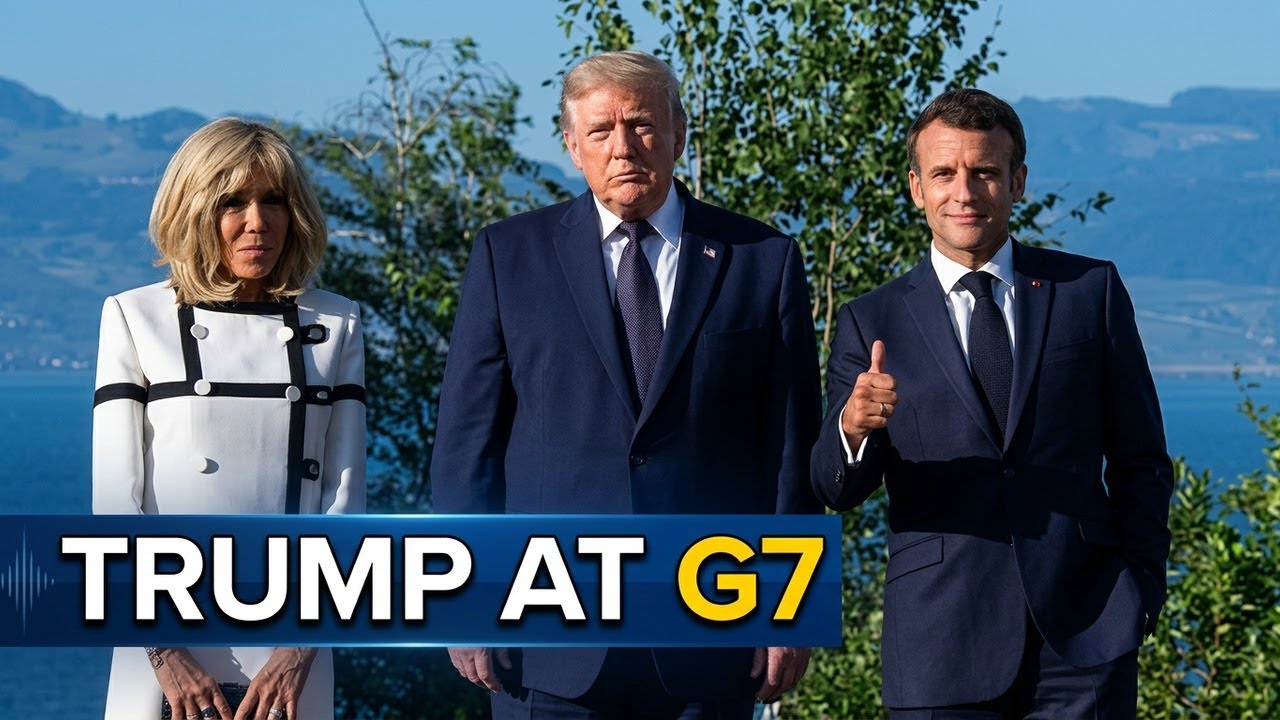
World leaders have gathered in Évian, France, for the G7 summit from June 15 to 17, 2026, with French President Emmanuel Macron hosting the official welcome. The diplomatic gathering is set to address pressing global challenges, including the ongoing situation in Ukraine, the Middle East, trade tensions, artificial intelligence, energy security, and global economic uncertainty.
What happened at the Évian G7 Summit?
President Macron officially welcomed G7 leaders, representatives from the European Union, and invited partners to the summit. Among those attending are U.S. President Donald Trump, Italian Prime Minister Giorgia Meloni, German Chancellor Friedrich Merz, UK Prime Minister Keir Starmer, Canadian Prime Minister Mark Carney, and Japanese Prime Minister Sanae Takaichi. The European Union is represented by European Council President António Costa and European Commission President Ursula von der Leyen.
The agenda for the three-day summit includes discussions on geopolitical challenges, peace and security for Ukraine and Europe, the situation in the Middle East, and international partnerships. Leaders are also addressing more balanced economic growth and the future of artificial intelligence.
Why it matters for Europe
The G7 Évian summit comes at a critical juncture, as leaders face pressure to demonstrate that multilateral cooperation can effectively respond to major international challenges. According to António Costa, “This G7 summit is taking place at a defining moment.” He added that “The choices we make here will send a clear signal about our willingness to act, to cooperate, and to defend the principles that underpin global stability.”
For Europe, a key focus is maintaining U.S. attention on Ukraine and the Middle East, as well as addressing energy prices and global economic stability. Politico reports that expectations for Évian are low, with a primary goal for Macron being to keep U.S. President Donald Trump engaged in talks on Ukraine and Iran.
Emmanuel Macron also highlighted the importance of trade, stating, “Trade tensions are bad for growth.” He further emphasized, “We believe in a free trade based on rules that benefits all and the refusal of economic coercion.” Pascal Confavreux echoed calls for de-escalation, noting, “We’ll keep calling for restraint, because the escalation of violence is negative for all of us and … our own economies.”
Key points from the discussions
Discussions at the G7 Évian summit may focus less on major deals and more on keeping diplomatic channels open. Leaders are expected to issue several statements on specific topics rather than relying solely on one broad final communiqué. Politico reports that Évian may produce narrower declarations and summaries from Macron on geopolitical discussions.
Regarding Ukraine, Volodymyr Zelenskyy reportedly proposed a meeting with Vladimir Putin alongside the summit, but Moscow rejected the idea. The G7 countries did not immediately confirm such an initiative.
Background on the G7
The G7 comprises Canada, France, Germany, Italy, Japan, the United Kingdom, the United States, and the European Union. The group has met in the G7 format since 2014, following Russia’s violation of Ukraine’s sovereignty and territorial integrity, which led to its exclusion from the former G8.
What is the main focus of the G7 Évian summit?
The G7 Évian summit primarily focuses on geopolitical challenges, including the situations in Ukraine and the Middle East, alongside discussions on trade tensions, artificial intelligence, energy, and global economic uncertainty.
Who represents the European Union at the G7 summit?
The European Union is represented by European Council President António Costa and European Commission President Ursula von der Leyen at the G7 Évian summit.
What are the expectations for the summit’s outcomes?
Expectations for the G7 Évian summit are reportedly low, with leaders expected to issue several focused statements rather than a single broad communiqué. A key goal is to maintain diplomatic engagement on critical issues like Ukraine and Iran, particularly with U.S. President Donald Trump.
