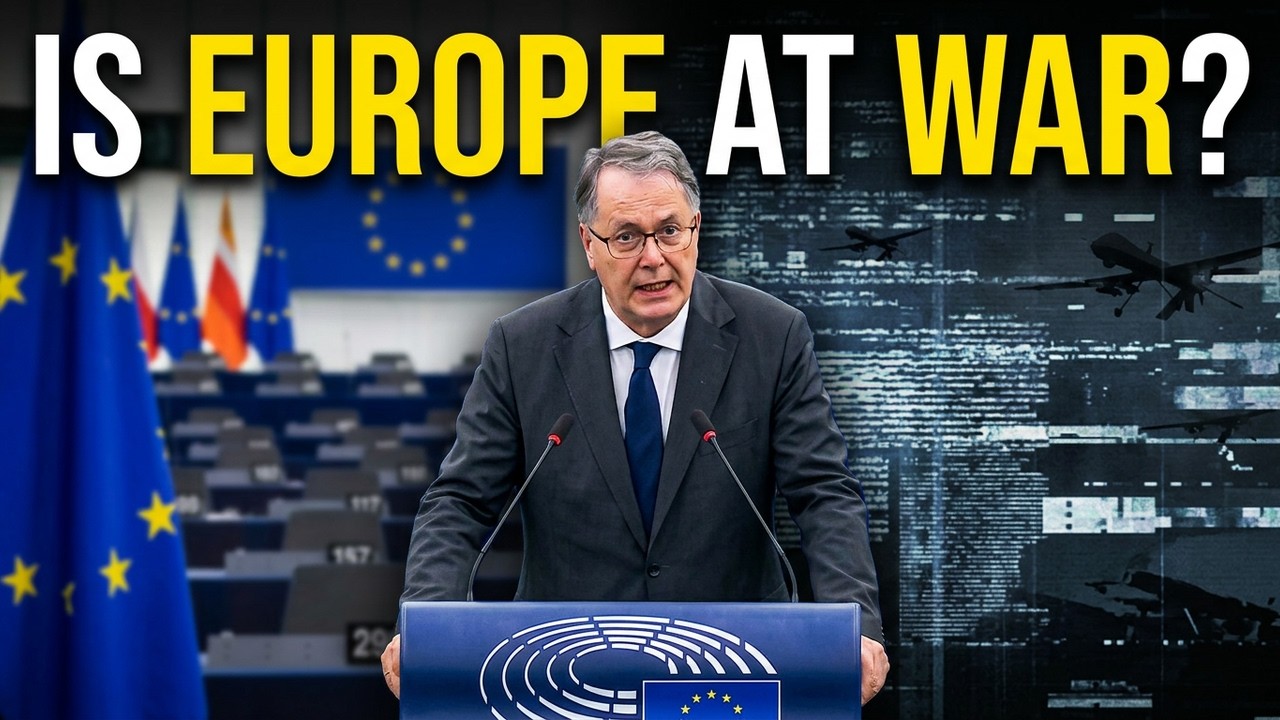
A recent European Parliament debate saw lawmakers deliver sharply different warnings and political arguments regarding hybrid threats targeting EU Member States. The discussion highlighted deep divisions among MEPs on how to define the threat and the appropriate European response.
Warnings of Calculated Attacks and State-Supported Terrorism
Estonian Prime Minister Kaja Kallas, speaking to MEPs, asserted that recent incidents involving Denmark, Lithuania, and Poland, alongside an attack near Ukraine’s border, were not accidental. She described them as “calculated attempts” by Russia to weaken European resolve, test unity, and exploit fears of escalation. Kallas cited a Russian warship firing flares at a Danish helicopter, NATO jets downing a drone over Lithuania, a Russian strike on a passenger train near Ukraine, and Poland recovering a drone from its waters.
Echoing a strong stance, Urmas Paet (Renew, Estonia) escalated the language, characterizing hybrid warfare as “state-supported terrorism.” He advocated for improved information exchange, stronger sanctions, action against Russian-linked actors, reinforced eastern borders, and continued assistance for Ukraine.
Villy Søvndal (Greens/EFA, Denmark) also warned that Russian aggression was moving closer to Europe and described recent incidents as part of “an actual hybrid war against Europe.” He stressed that European unity should be the primary response to further escalation.
Divided Views on Scope and Response
While many expressed alarm, Pierre-Romain Thionnet (PfE, France) challenged the framing of the threat, stating, “We’re not at war today.” While acknowledging intimidation, propaganda, and destabilisation, he questioned proposals to grant the European Commission a stronger operational role in crisis management.
Nicolás Pascual de la Parte (EPP, Spain) highlighted that hybrid pressure extends beyond Eastern Europe, referencing incidents in Ceuta. He called for greater EU involvement in controlling external borders and an independent investigation into what he termed an organised “invasion” of Ceuta.
Sven Mikser (S&D, Estonia) broadened the definition of hybrid operations, warning they target more than just physical infrastructure like cables, pipelines, or servers. He argued they are designed to undermine democracy, the rule of law, and social cohesion by exploiting divisions and spreading disinformation.
The Ukraine War and European Unity
Adam Bielan (ECR, Poland) directly linked hybrid attacks to the ongoing war in Ukraine, urging Europe to end Russian supplies worth over €5 billion. He also called for a strong alliance with the United States, increased defence spending, and sustained support for Ukraine.
Conversely, Milan Uhrík (ESN, Slovakia) strongly criticised continued funding for Ukraine, arguing that the conflict lacks a military solution. He questioned further European support and pressed for stronger efforts to end the war.
Merja Kyllönen (The Left, Finland) focused on the importance of trust and resilience, emphasising the need to protect critical infrastructure, ensure reliable information, and maintain public confidence in democratic institutions.
The debate underscored broad concern about hostile activities targeting European countries but also revealed deep political disagreements over Russia, Ukraine, sanctions, defence policy, border management, and the precise role of EU institutions. As Sven Mikser concluded, “A divided Europe is a weak Europe.”
What is a hybrid threat?
Hybrid threats involve a combination of conventional and unconventional tactics, including disinformation, cyberattacks, economic pressure, and military actions below the threshold of declared war, aimed at destabilizing an adversary.
How divided is the European Parliament on hybrid warfare?
The European Parliament is significantly divided, with some MEPs describing current incidents as “an actual hybrid war against Europe,” while others explicitly state, “We’re not at war today,” questioning the language and proposed responses.
What actions are MEPs calling for to counter hybrid threats?
MEPs have called for stronger sanctions against Russia, reinforced eastern and southern borders, better information exchange, increased defence spending, continued support for Ukraine, and protecting critical infrastructure and democratic institutions.