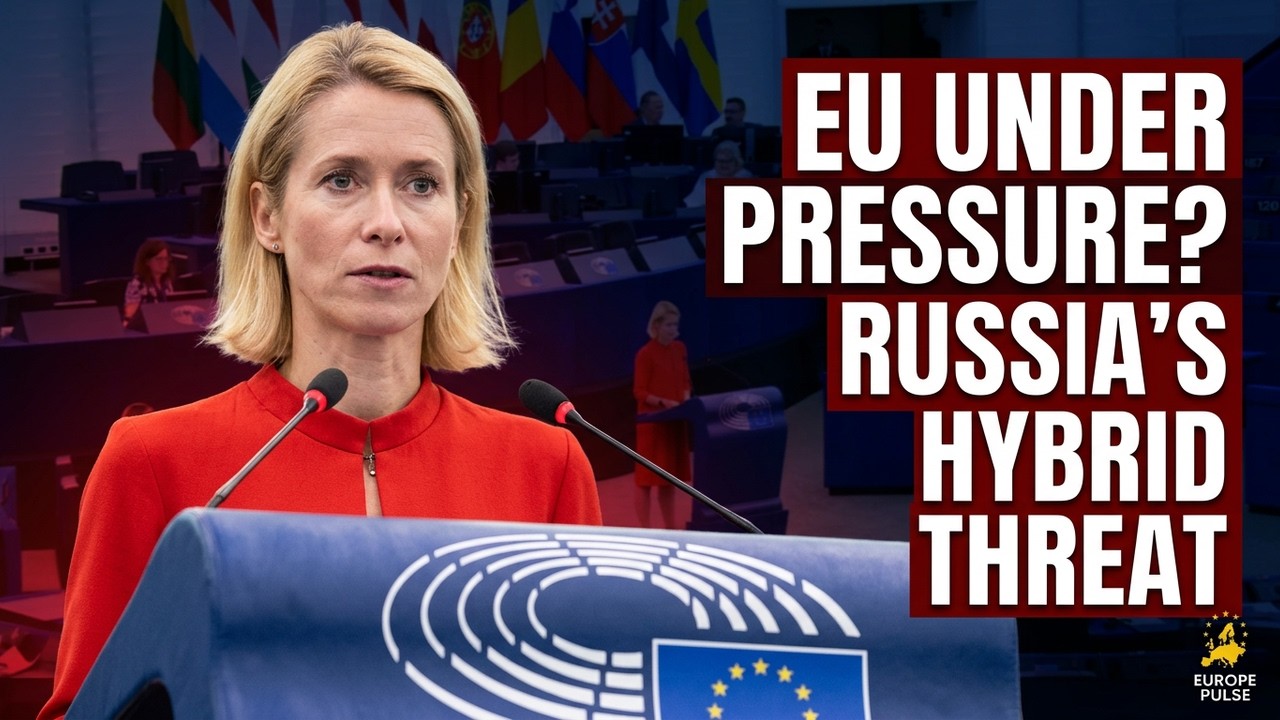
Kaja Kallas, the EU High Representative for Foreign Affairs and Security Policy, has issued a stark warning to the European Parliament, stating that Russia’s hybrid attacks against Europe are on the rise and demanding a stronger, more coordinated European response. Speaking during a debate on hybrid attacks against EU Member States, Kallas emphasized that “Putin will not stop unless he is stopped,” describing the Russian leader as a “textbook bully.”
Escalating Hybrid Warfare Against Europe
Kallas thanked rapporteur Rosa Junkiewicz for her report on Russia’s hybrid warfare, noting its accurate portrayal of the situation and the urgent need for action. She highlighted a steady increase in hybrid attacks since Russia’s full-scale invasion of Ukraine began in 2022. Kallas cited recent incidents from the previous 48 hours, including a Russian warship firing flares at a Danish helicopter, NATO jets intercepting a drone over Lithuania, a strike on a passenger train near Ukraine’s border, and Poland recovering a drone from its waters. “Those are not accidents,” Kallas stated. “They are calculated attempts by Russia to weaken our resolve, test our unity, and play with fears of escalation.”
She explained that Russia adapts its tactics to target specific countries, employing interference in the information space and elections, exploiting societal divisions, and conducting physical attacks against military infrastructure, public transport, and critical infrastructure. Kallas characterized Russia’s alleged hybrid activity as a growing European security threat aimed at undermining resolve, testing European unity, and exploiting fears of escalation.
A Coordinated European Response to Hybrid Threats
To counter this aggression, Kallas called for broader intelligence cooperation among EU countries, covering Russia’s entire “hybrid toolbox,” and greater utilization of the EU’s Intelligence and Situation Center. She outlined several measures Europe should pursue, including systematically attributing attacks, sanctioning those responsible, cutting Russian funding, restricting diplomatic movements and visas, and strengthening Europe’s ability to detect and counter foreign information manipulation and interference.
The EU has already taken steps, sanctioning nine individuals and four entities, and its sanctions have reportedly deprived the Russian economy of €1 trillion. Diplomatic efforts have also led to hundreds of ships linked to Russia’s shadow fleet being de-flagged, and the Russian mission to the EU has been capped at 40 staff. Hungary recently expelled 10 Russian diplomats, and Kallas suggested that additional restrictions could be considered.
Kallas also presented several possible additional measures, such as tighter controls on Russian diplomats, a proposed ban on visas for Russian ex-combatants, and a review of tourist visas for Russian citizens. She made it clear that despite escalating pressure from Moscow, “Europe will not dial back its support for Ukraine as Russia escalates.” She urged, “We should not let fear dictate our choices.”
FAQ
What did Kaja Kallas warn the EU Parliament about?
Kaja Kallas warned the EU Parliament about the increasing frequency and sophistication of Russian hybrid attacks against Europe, calling for a stronger, coordinated European response to these EU hybrid threats.
What measures did Kallas propose to counter Russian hybrid threats?
Kallas proposed enhanced intelligence sharing, systematic attribution of attacks, sanctions against those responsible, cutting Russian funding, restricting diplomatic movements and visas, and strengthening defenses against foreign information manipulation. She also mentioned possible additional measures like tighter controls on Russian diplomats and visa restrictions for certain Russian citizens.
How has the EU already responded to Russian aggression?
The EU has sanctioned nine individuals and four entities, deprived the Russian economy of €1 trillion through sanctions, de-flagged hundreds of ships linked to Russia’s shadow fleet, and capped the Russian mission to the EU at 40 staff. Hungary also recently expelled 10 Russian diplomats.