
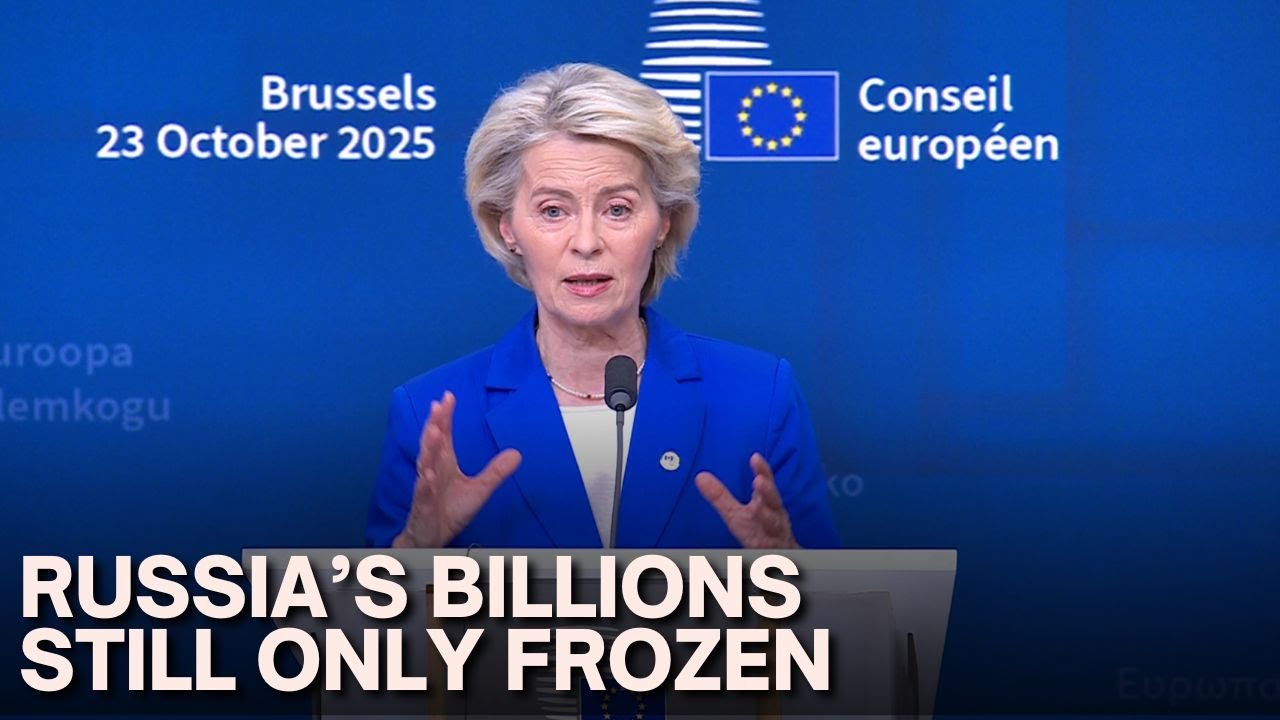
EU Leaders Delay Decision on Using Frozen Russian Assets for Ukraine, as von der Leyen Announces New Sanctions Package
#FrozenRussianAssets #EUSummit #UrsulaVonDerLeyen
European Union leaders have postponed a long-awaited decision on whether frozen Russian assets should be used to fund Ukraine’s reconstruction, following tense discussions at this week’s Brussels summit. The issue is expected to return to the agenda in December after member states failed to reach a consensus — with Belgium again raising concerns over legal and financial risks.
Belgium’s hesitation is significant, as most of the EU’s immobilized Russian assets — estimated at over €200 billion — are held within the Brussels-based financial clearinghouse Euroclear. Officials in Brussels fear that unilateral use of these funds could expose the EU to lawsuits or undermine financial stability.
Out of the 27 EU member states, 26 voted in favor of the summit conclusions, with Hungary once again standing alone in opposition, continuing its resistance to tougher measures against Moscow. The final statement only invited the European Commission to “present options” for financial support to Ukraine, omitting any specific reference to the frozen assets themselves.
Speaking after the summit, European Commission President Ursula von der Leyen confirmed that leaders had adopted the 19th EU sanctions package against Russia, describing it as “a wide-ranging and extensive package that hits at the heart of the Russian war economy.” She welcomed the parallel rollout of new U.S. sanctions, stressing that coordinated Western pressure “will continue for as long as it takes” to secure peace and accountability for Ukraine.
Von der Leyen noted that discussions with Ukrainian President Volodymyr Zelensky had helped clarify key issues concerning a possible “reparations loan” backed by immobilized Russian assets. However, she emphasized that any future step “will fully respect European and international law.”
Beyond Ukraine, EU leaders also discussed defense readiness, agreeing on a “Roadmap for Readiness 2030” that aims to fill military capability gaps in coordination with NATO. The plan envisions up to €800 billion in defense investments by 2030, which von der Leyen said should “create jobs and drive innovation” within Europe.
The summit further addressed Europe’s clean tech competitiveness, with leaders pledging to strengthen support for products “made in Europe” and to ensure foreign investment contributes to EU jobs and technology transfer. Von der Leyen also reaffirmed climate targets — with a 90% emissions reduction goal by 2040 and net-zero by 2050 — calling the approach “ambitious but pragmatic.”
Despite progress in several areas, the summit ended without consensus on how to unlock the vast frozen Russian assets, leaving one of Europe’s most politically sensitive questions unresolved. The debate is now expected to intensify ahead of the next European Council meeting in December.
0:00 — Sanctions & Ukraine Support: 19th package, asset-backed loan
1:11 — Defense Focus: Readiness Roadmap 2030 & 360° approach
2:33 — Spending Surge: up to €800bn, jobs, NATO alignment
3:20 — Competitiveness & Climate: Made-in-Europe, clean tech, 2040 target
——————————————————
*Subscribe to Europe Pulse*
Stay updated with the latest news from Europe.
#EuropePulse #BreakingNews #EU #WorldNews #Politics #TrendingNow #NewsUpdate #Analysis #Ukraine #Russia #USA #UK #EuropeanUnion #NATO #WorldEvents #CurrentAffairs #EUnews #TopStories #InternationalNews #Brussels #Leaders #ViralNews #Headlines
