
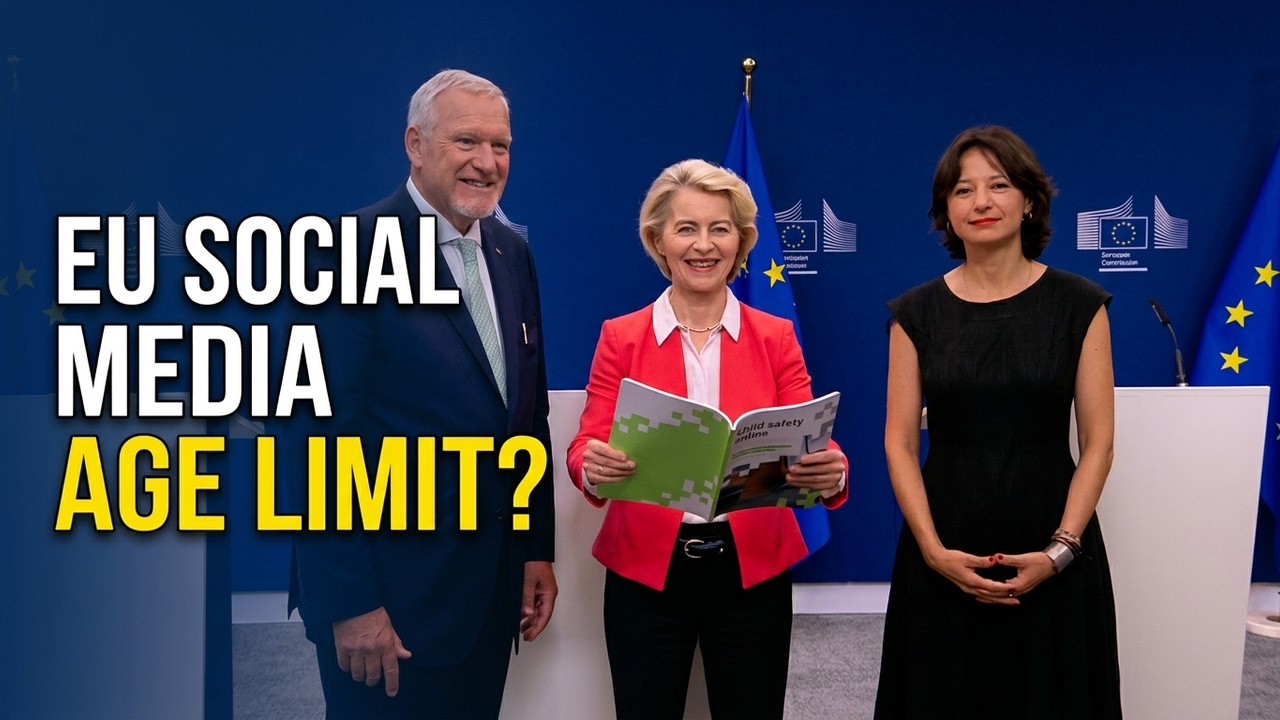
European Commission President Ursula von der Leyen has received an expert report proposing new EU-wide rules to enhance child online safety, including age restrictions for social media and greater tech company responsibility. The Commission will review the recommendations and aims to prepare a legislative proposal after the summer.
Proposed Framework for Child Online Safety
The report, titled “Child safety online: Protecting and empowering minors in a digital world,” was presented by Special Panel co-chairs Prof. Dr. Jörg M. Fegert and Dr. Maria Melchior. It recommends a harmonised EU-wide restriction for children under 13 from accessing social media and a broader “social media+” category, which includes social networks, app stores, video-sharing platforms, games, and AI companions. Exceptions would allow supervised, age-appropriate, and educational use.
For adolescents aged 13 to 18, the report supports a path towards gradual autonomy, contingent on providers proving their products are safe by design or default and age-appropriate. Member States could introduce additional restrictions above 13, while an EU framework would help reduce fragmentation across the bloc.
Ursula von der Leyen underscored the urgency, stating, “Social media is not a toy.” She added, “This is not about whether children can access social media. It is about whether and when social media can access our children.”
Strengthening Platform Responsibility and Safeguards
A core recommendation is to shift the burden of proof to tech companies, requiring them to demonstrate that their services and features are safe for minors before children can access them. The report identifies several design elements requiring safeguards, including infinite scrolling, autoplay, persistent notifications, dark patterns, unsolicited contacts, and problematic recommendation systems.
Private age checks are also proposed, advocating for secure, proportionate, and privacy-preserving systems that avoid using identity documents or biometric information for age estimation, highlighting technologies like Zero Knowledge Proof. Furthermore, the report calls for priority handling of complaints from children and adolescents through accessible, effective, and child-friendly systems. Prof. Dr. Jörg M. Fegert stressed, “Complaints from children and adolescents must finally be prioritized.”
The recommendations also address the critical issue of online child sexual abuse, urging clear obligations for digital service providers to prevent, detect, report, and block such material, noting that over 80% of investigations in this area originate from provider reports.
Fostering Digital Literacy and Offline Life
Beyond restrictions, the report advocates for a comprehensive approach that includes digital and AI literacy, deepfake and disinformation awareness, and privacy skills for young people. It also highlights the importance of supporting parents and teachers with guidance and training. Dr. Maria Melchior noted, “The digital world is rich, but it will never replace real life.”
Crucially, the report emphasizes the need to promote offline activities, mental health support, youth participation, and research access, acknowledging that digital services can support learning, creativity, and social connection while advocating for precautionary protection.
Next Steps for EU Child Online Safety
The report serves as an expert recommendation and does not constitute adopted EU legislation. The European Commission will now review its findings and is expected to present its own legislative proposal after the summer, aiming to create a lasting response to the challenges minors face in the digital world. Prof. Dr. Jörg M. Fegert concluded, “A whole ecosystem around children must change. But we don’t have time.”
What does the report propose for children under 13?
The report recommends an EU-wide restriction for children under 13 from accessing social media and a broader “social media+” category, with limited exceptions for supervised, age-appropriate, and educational use.
What is the proposed role of tech companies?
Tech companies would be required to prove that their products and features are safe for minors before they can access them. The report also calls for safeguards against harmful design elements and clear obligations to prevent and report child sexual abuse material.
What are the next steps for EU action?
The European Commission will review the expert report and plans to prepare a legislative proposal after the summer. The report itself is a recommendation and not yet EU law.
Watch the full Europe Pulse video
The related Europe Pulse video is available below.
