
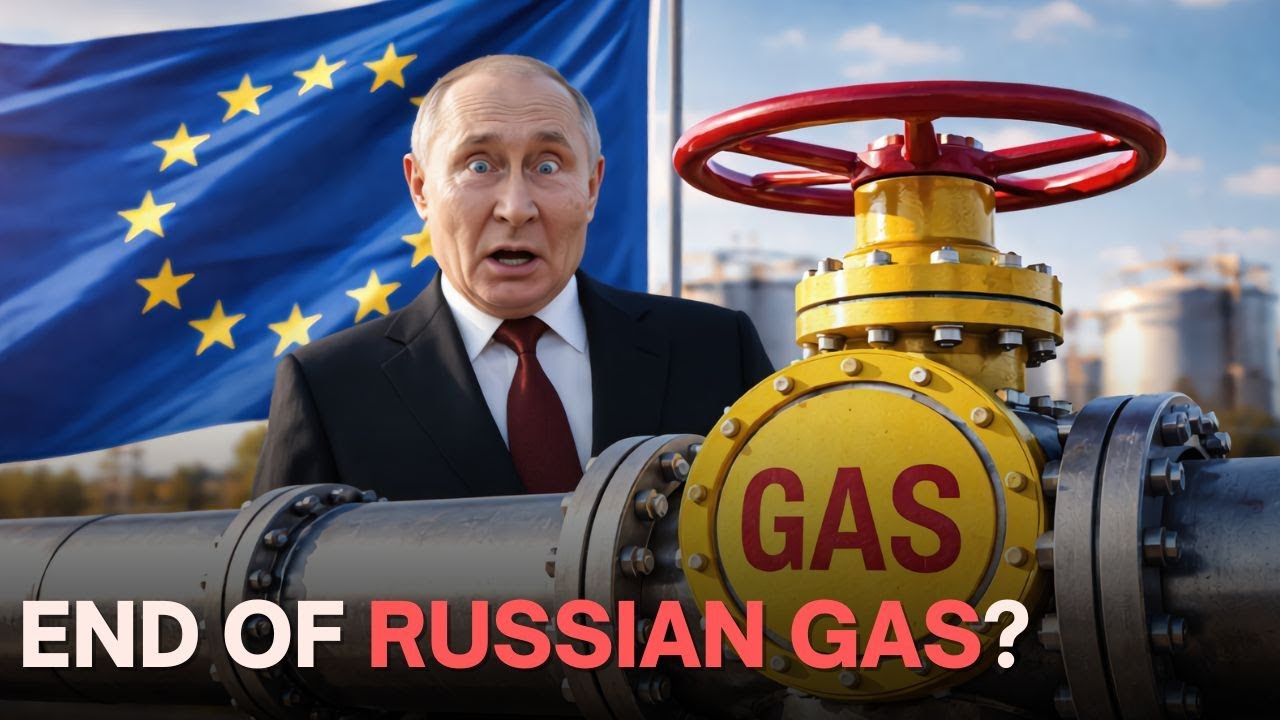
The European Union is preparing to permanently end imports of Russian natural gas, marking one of the most far-reaching energy decisions in its history. The move, debated this week in the European Parliament in Strasbourg, is designed to protect the EU from the political weaponisation of energy and to close a chapter of long-standing dependence on Moscow.
Supporters describe the legislation as a moral, strategic, and geopolitical turning point. Critics warn of higher energy costs, inflationary pressure, and the risk of replacing one dependency with another — particularly on liquefied natural gas (LNG).
What the New EU Law on Russian Gas Does
The proposed regulation, provisionally agreed by negotiators from the European Parliament and the Council, goes beyond temporary sanctions. Instead, it establishes a permanent legal ban on Russian gas imports.
Key elements include:
-
Early 2026: A ban on Russian LNG imports purchased on the spot market
-
30 September 2027: A full phase-out of Russian pipeline gas
-
Enforcement mechanisms: Member States must apply penalties to operators that violate the rules
Unlike sanctions, which require regular political renewal, the regulation creates a stable legal framework intended to block Russian gas from the EU’s energy system long-term.
Why Energy Became a Security Issue
The legislation is a direct response to Russia’s long-documented use of energy as a political weapon — a pattern that intensified after the full-scale invasion of Ukraine in 2022.
That year, Russia sharply reduced gas flows to Europe, underfilled EU gas storage facilities, and halted major pipelines. The result was an unprecedented market shock, with energy prices in some cases rising up to eight times pre-crisis levels.
Since the start of the war, the EU has paid over €216 billion for Russian fossil fuels, with tens of millions of euros still flowing daily. For many lawmakers, this financial link is no longer politically or morally acceptable.
The Moral and Geopolitical Argument
Supporters of the ban argue that energy imports are not a neutral economic exchange when they fund military aggression.
Members of the European Parliament repeatedly framed the vote as a “never again” moment — ending both financial support for Russia’s war and the vulnerability that comes with strategic dependence.
From this perspective, phasing out Russian gas is not only about energy markets, but about European unity, credibility, and resilience in the face of coercion.
The Cost and Inflation Concerns
Opposition voices do not dispute the security risks posed by Russian gas. Instead, they question the economic consequences of how Europe replaces it.
Liquefied natural gas, particularly LNG imported by ship, is structurally more expensive than pipeline gas. It requires liquefaction, maritime transport, and regasification — each step adding cost.
Critics warn that these higher costs will ultimately be passed on to households and businesses, increasing energy bills and contributing to inflation at a time when many European economies remain under pressure.
Energy Sovereignty or New Dependency?
One of the most striking points of consensus across political groups was a shared warning: ending dependence on Russia must not lead to dependence on another supplier.
Several lawmakers cautioned against over-reliance on American LNG, arguing that true energy sovereignty cannot be achieved through imports alone. Instead, they called for accelerated investment in:
-
Renewable energy production
-
Energy efficiency and building renovation
-
Reduced overall energy demand
According to this view, the Russian gas ban should be a catalyst for a deeper transformation of Europe’s energy system — not merely a change of supplier.
What Happens Next
The European Parliament is expected to vote on the regulation on Wednesday. If adopted, it will lock in a clear timetable for ending Russian gas imports and reshape Europe’s energy landscape for decades.
The debate now moves beyond whether Europe can live without Russian gas. The central question is whether the EU can use this moment to finally build a resilient, affordable, and sovereign energy system — or whether new vulnerabilities will emerge in its place.
Related Topics
EU energy policy • Russian gas ban • European Parliament • LNG imports • Energy security • Ukraine war • Renewable energy • European sovereignty
