
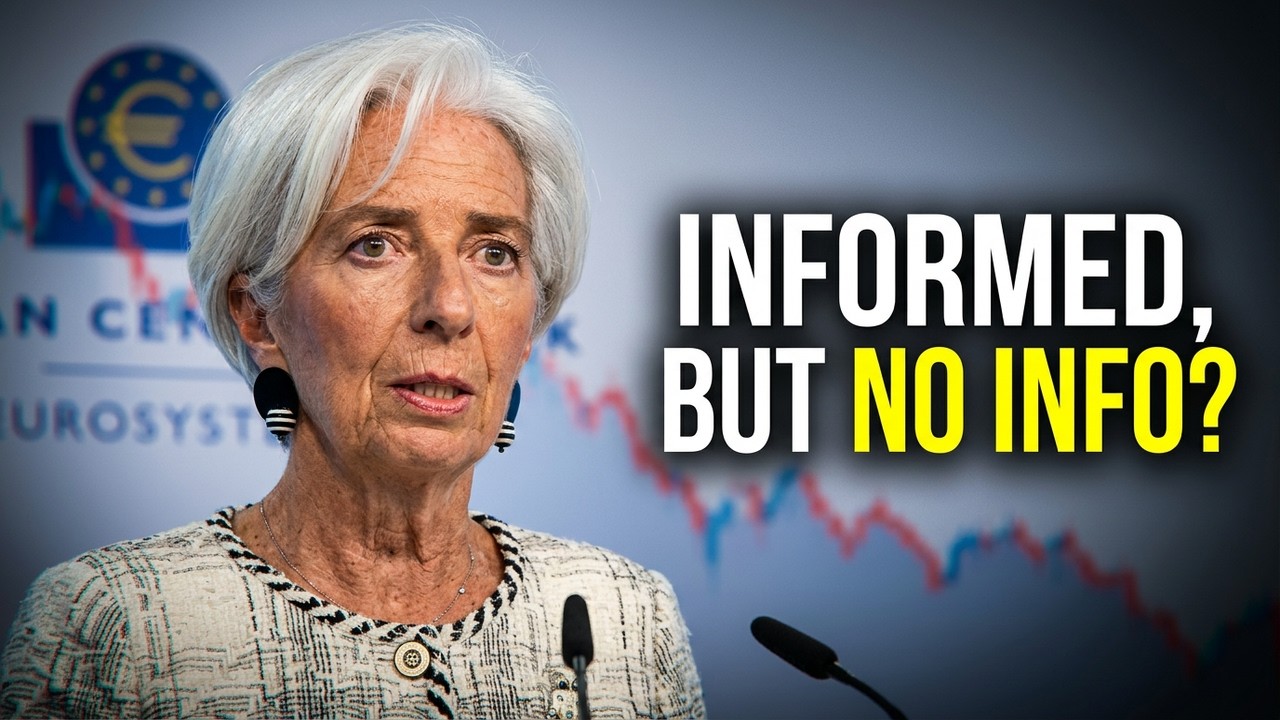
# ECB’s Stark Admission: Lagarde Confesses ‘Insufficient Data’ in Crucial 2026 Decision – Is Europe Drifting Towards Crisis?
**Frankfurt, Europe Pulse Exclusive** – In a revelation that sent immediate shockwaves through financial markets and political capitals alike, European Central Bank (ECB) President Christine Lagarde delivered arguably one of the most candid and unsettling statements of her tenure this week. Addressing a press conference following the ECB’s critical 2026 monetary policy decision, Lagarde admitted the institution had made an “informed decision based on insufficient information.” The extraordinary admission has reignited fears of a looming economic crisis, leaving many to question whether Europe is heading towards a dreaded era of stagflation or if the truth behind the continent’s economic woes runs even deeper.
The statement itself is a bombshell. For a central bank, tasked with maintaining price stability and guiding the Eurozone through turbulent waters, to acknowledge a fundamental data deficit in a major policy decision is unprecedented. It suggests that the ECB, far from being a bastion of foresight and control, is navigating the European economy with a severely dimmed radar, making critical choices in a fog of uncertainty.
## The Specter of Stagflation: 1970s Redux or a New Economic Reality?
The core of the unfolding debate centres on the very nature of Europe’s economic affliction. With inflation stubbornly above the ECB’s 2% target and growth visibly slowing across the bloc, the term “stagflation” has re-entered the lexicon with alarming frequency. This economic paradox – high inflation coupled with stagnant economic growth and rising unemployment – evokes painful memories of the 1970s, a decade marked by oil shocks, industrial unrest, and a prolonged period of economic malaise.
### Lagarde’s Rejection of the 1970s Parallel
Lagarde, however, firmly pushed back against comparing today’s challenges with the 1970s. She argued that the fundamental structure of the European economy has undergone significant transformation. “Today’s labour markets are far more flexible, our energy dependency, while still a concern, is diversifiying, and the institutional frameworks, including the independence of the ECB itself, are vastly different,” Lagarde asserted. Her argument posits that the tools and understanding available to policymakers in 2026 are superior, preventing a repeat of past policy missteps.
Yet, despite her reassurances, the parallels are increasingly hard to ignore for many economists and citizens alike. The current scenario features:
* **Persistent Inflation:** Fuelled by supply chain disruptions, tight labour markets, and now, significantly, geopolitical tensions.
* **Weakening Growth:** Evident in slowing industrial output, declining consumer confidence, and revised downward GDP forecasts.
* **External Shocks:** Predominantly, the impact of ongoing geopolitical conflicts, most notably in the Middle East, on global energy markets.
## Geopolitical Headwinds: The Middle East Conflict’s Inflationary Grip
The Middle East conflict, a tragic human crisis, has evolved into a formidable economic disruptor for Europe. Its ripple effects are primarily felt through energy markets, where renewed volatility and upward price pressures on oil and gas are directly feeding into the Eurozone’s inflation problem. This external shock complicates the ECB’s already challenging task, pushing up input costs for businesses and electricity bills for households, eroding purchasing power and stifling economic activity.
“These external shocks, by their very nature, are difficult to predict and harder to quantify their precise economic impact,” acknowledged Lagarde, hinting at the very “insufficient information” she later referenced. The highly unpredictable nature of geopolitical events makes long-term economic forecasting a high-stakes gamble, further undermining confidence in the ECB’s ability to chart a clear path.
## Can the ECB Really Hit 2%? Monetary Policy in the Fog
The ECB’s primary mandate is to maintain price stability, typically defined as inflation around the 2% target over the medium term. Lagarde’s admission of operating with “insufficient information” throws a significant shadow over the institution’s capacity to achieve this critical goal.
If the ECB is making policy decisions – be it adjusting interest rates, winding down asset purchase programs, or providing forward guidance – without a comprehensive understanding of the underlying economic dynamics, the risk of miscalibration rises dramatically.
* **Tightening too much:** Could inadvertently push an already slowing economy into recession, exacerbating unemployment.
* **Not tightening enough:** Risks allowing inflation to become entrenched, requiring even more aggressive measures down the line and eroding public trust in the currency.
The dilemma facing the ECB is profound. Raising interest rates to combat inflation, particularly if it’s driven by supply-side shocks like energy prices, can stifle demand and growth without necessarily addressing the root cause of rising prices. Conversely, holding rates low to support growth risks embedding higher inflation expectations. The “decision without enough data” implies the ECB is struggling to find this delicate balance, potentially relying on intuition as much as empirical evidence.
## Economic Crisis Risks: What Does This Mean for Europe’s Future?
The confluence of factors – persistent inflation, slowing growth, geopolitical instability, and now, the ECB’s candid admission of an informational void – paints a concerning picture for Europe. The risk of a significant economic crisis in 2026, whether it takes the precise form of 1970s-style stagflation or a new, equally challenging manifestation, appears increasingly tangible.
For citizens, the implications are direct and personal:
* **Your Money:** Continued erosion of purchasing power, higher borrowing costs (mortgages, loans), and uncertainty over savings.
* **Your Economy:** Increased job insecurity, reduced investment, and slower wage growth.
* **Europe’s Future:** A potential period of prolonged economic stagnation that could test the resilience of the Eurozone and impact its standing on the global stage.
The ECB’s press conference was more than a routine update; it was a rare moment of stark honesty that laid bare the immense challenges facing European policymakers. While Christine Lagarde’s candour might be commendable, it ultimately underscores a deep-seated uncertainty at the very heart of Europe’s economic governance. The real meaning behind her words is clear: Europe is at a critical juncture, navigating treacherous waters with incomplete charts. Europe Pulse will continue to break down these developments, providing the insights you need to understand what this means for your financial well-being and the continent’s trajectory.
