
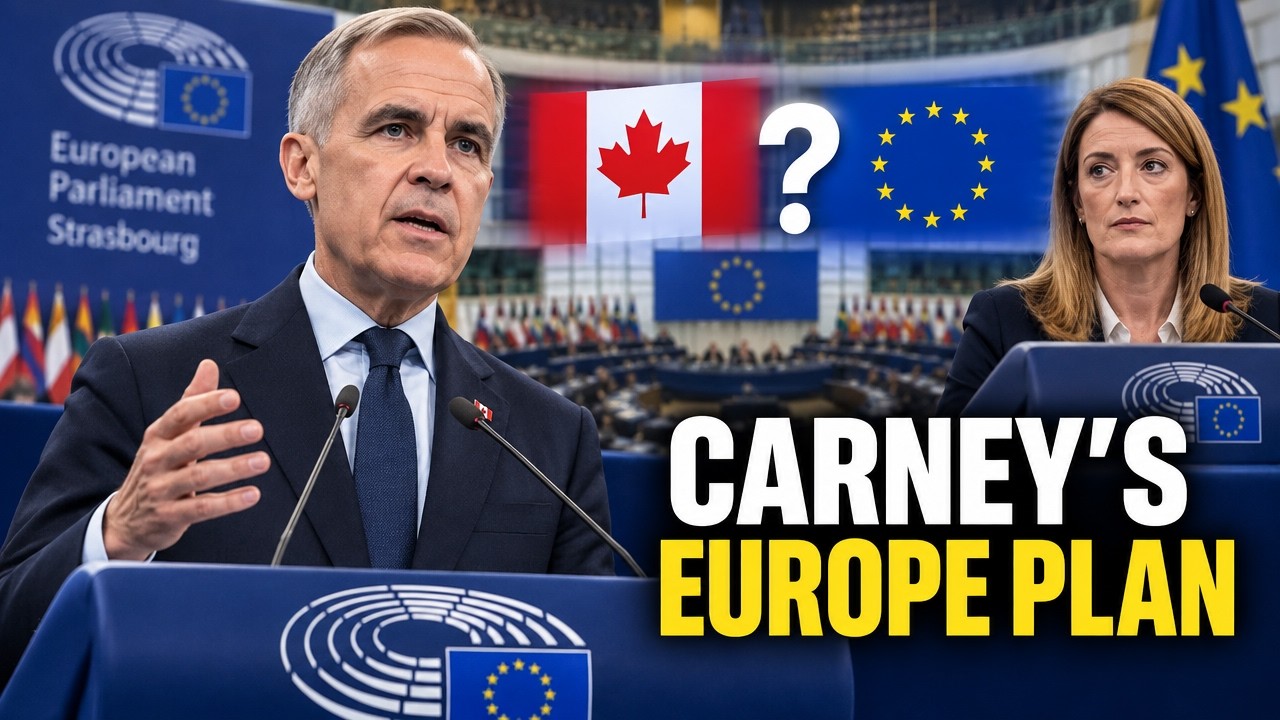
Canadian Prime Minister Mark Carney has unveiled a proposal for a significantly deeper partnership between Canada and the European Union, which he describes as an “alliance for the future.” Speaking in the European Parliament in Strasbourg and later alongside Parliament President Roberta Metsola, Carney outlined a vision for enhanced cooperation built around strategic resilience, trade, defence, critical minerals, energy, and artificial intelligence.
A Vision for Collective Resilience
In his address, Mark Carney argued that increasing geopolitical and economic disruption necessitates Canada and Europe strengthening their collective ability to withstand external pressures. He emphasized that the objective is not complete self-sufficiency, but rather “collective resilience,” achieved through closer collaboration. Proposed areas for this deeper cooperation include critical minerals, defence industrial capacity, AI and computing, energy security, space, and payment systems.
Carney highlighted Canada’s significant natural resources, noting that the country holds deposits of over 34 critical minerals and is a leading producer of 10 minerals essential for the energy transition. This offers a strong foundation for strengthening supply chains with Europe.
Deepening Economic and Social Ties
Beyond strategic resilience, Carney also proposed closer economic and social integration. His ideas include more seamless digital trade in non-agricultural goods and services, and stronger mobility opportunities for young Canadians and Europeans. He raised the possibility of Canadian participation in programs like Erasmus+ and the next generation of Horizon, fostering educational and research links.
Roberta Metsola, speaking at the joint press conference, affirmed the European Parliament’s view of Canada as an ally and partner, citing existing cooperation through CETA and security ties. She announced the European Parliament’s plan to open an antenna office within the EU delegation in Ottawa, signaling a tangible step towards deepening relations in areas such as energy, connectivity, AI, education, defence, and the Arctic. Metsola also noted that trade in goods under the EU–Canada relationship has increased by 75%.
Defining the Canada EU Alliance for the Future
Carney was careful to define the scope of his proposal, stating clearly that Canada is not seeking full membership of the European Union. He indicated that the precise terminology, including the idea of “associate membership” previously raised by European Commission President Ursula von der Leyen, would be for Europe to determine, with the substance of the partnership being paramount. “Canada is not in a position nor seeking to become a full member of the European Union,” Carney stated.
He presented the proposed relationship as a proactive measure for both Canada and Europe to become more resilient and less vulnerable to external pressures across supply chains, technology, energy, finance, and strategic dependencies. “This is for a better future for our citizens. It’s not a reaction to something else,” Carney added.
The Canadian Prime Minister described his proposal as the beginning of a process, pointing to the upcoming Canada–EU summit in Montreal on 29 and 30 October as an important next step. He clarified that any final structure for the alliance would ultimately require debate and a vote in the Canadian Parliament.
FAQ
What is the “alliance for the future” proposed by Mark Carney?
The “alliance for the future” is a proposed deeper partnership between Canada and the European Union, aiming for collective resilience and enhanced cooperation across strategic areas like trade, defence, critical minerals, energy, and AI.
Is Canada seeking full EU membership?
No, Mark Carney explicitly stated that Canada is not seeking full membership of the European Union. The proposal focuses on a substantive partnership and collective resilience.
What are the next steps for this proposed partnership?
The proposal is at the beginning of a process, with the next Canada–EU summit in Montreal on 29 and 30 October identified as an important next step. Any final framework would require political and parliamentary decisions in Canada.
