
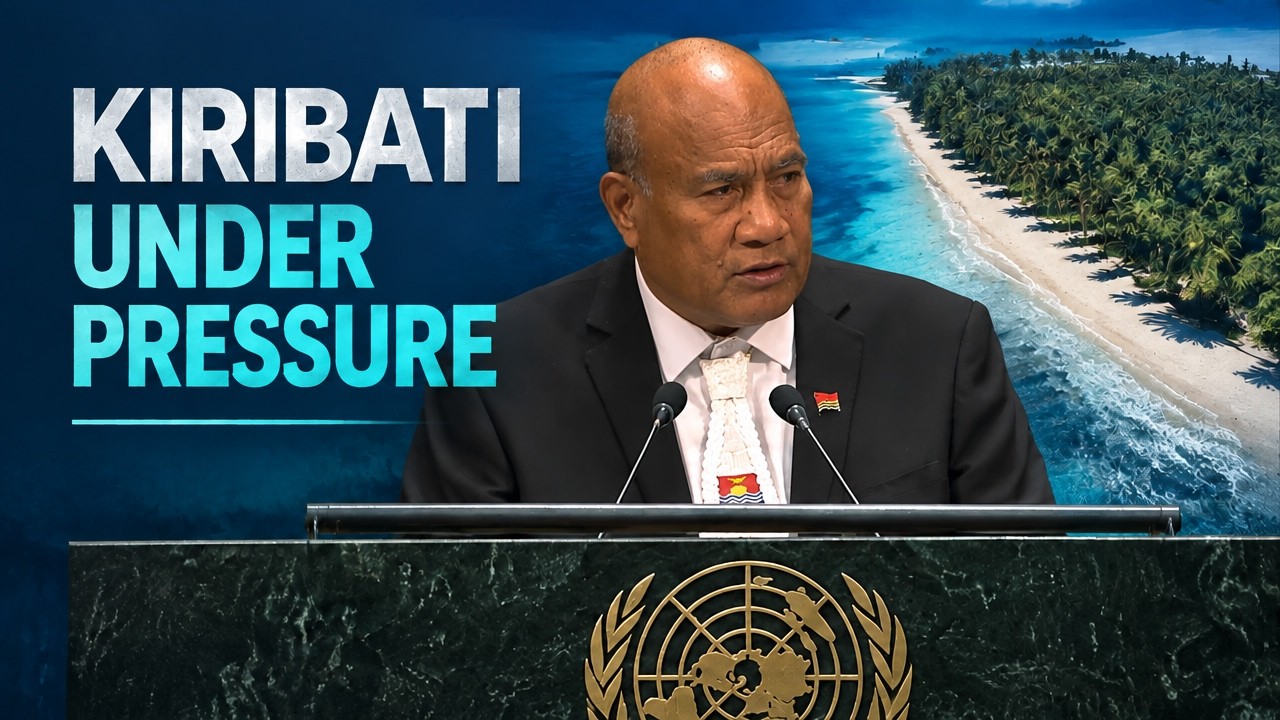
Kiribati President Taneti Maamau delivered an urgent address at the 81st session of the United Nations General Assembly on 25 September 2026, detailing the profound challenges facing his island nation. President Maamau highlighted how climate change, the legacy of nuclear testing, and emerging digital vulnerabilities are placing immense pressure on Kiribati’s communities and way of life.
Climate Impacts and Kiribati’s Resilience Efforts
In his speech, President Maamau emphasized Kiribati’s identity as an “ocean nation” and a “Big Ocean Sustainable State,” underscoring its deep dependence on healthy marine resources for its economy, food security, livelihoods, and culture. He outlined the critical climate impacts already affecting the islands, stating that “Sea-level rise, coastal erosion, saltwater intrusion and extreme weather events continue to place pressure on our communities, infrastructure, water security and livelihoods.”
In response to these escalating threats, Kiribati is actively investing in comprehensive resilience measures. These include initiatives focused on water security, coastal protection, disaster preparedness, and the transition to renewable energy. The nation is also implementing community-based adaptation strategies to empower local populations in facing climate challenges.
Addressing Nuclear Legacy and Digital Threats
Beyond climate change, President Maamau also drew attention to other significant risks confronting Pacific island states. He noted that the Pacific region continues to bear the human and environmental legacy of past nuclear testing, a burden that still impacts its communities.
Furthermore, the address highlighted new digital vulnerabilities. With the East Micronesia Cable connecting Kiribati with Nauru and the Federated States of Micronesia, the nation faces modern threats such as cybercrime, attacks on critical infrastructure, and ransomware. Maamau warned that limited redundancy and technical capacity leave island states particularly susceptible to these digital dangers.
A Call for Global Support and a Chosen Future
President Maamau called for stronger international support for adaptation efforts and for climate finance that is adequate, predictable, and accessible to small island developing states. He concluded his address with a powerful message about national determination, stating, “We come to speak of the future we choose.” His plea highlights the urgent need for global cooperation to help vulnerable nations like Kiribati navigate a complex array of environmental, historical, and technological challenges.
Frequently Asked Questions
What challenges did Kiribati’s President highlight at the UN?
Kiribati President Taneti Maamau highlighted severe climate impacts like sea-level rise and coastal erosion, the ongoing legacy of nuclear testing in the Pacific, and new digital vulnerabilities including cybercrime and infrastructure attacks.
What is Kiribati doing to address climate risks?
Kiribati is investing in water security, coastal protection, disaster preparedness, renewable energy, and community-based adaptation to build resilience against climate change impacts.
What kind of international support did President Maamau request?
President Maamau called for stronger support for adaptation measures and for climate finance that is adequate, predictable, and accessible for small island developing states.
