
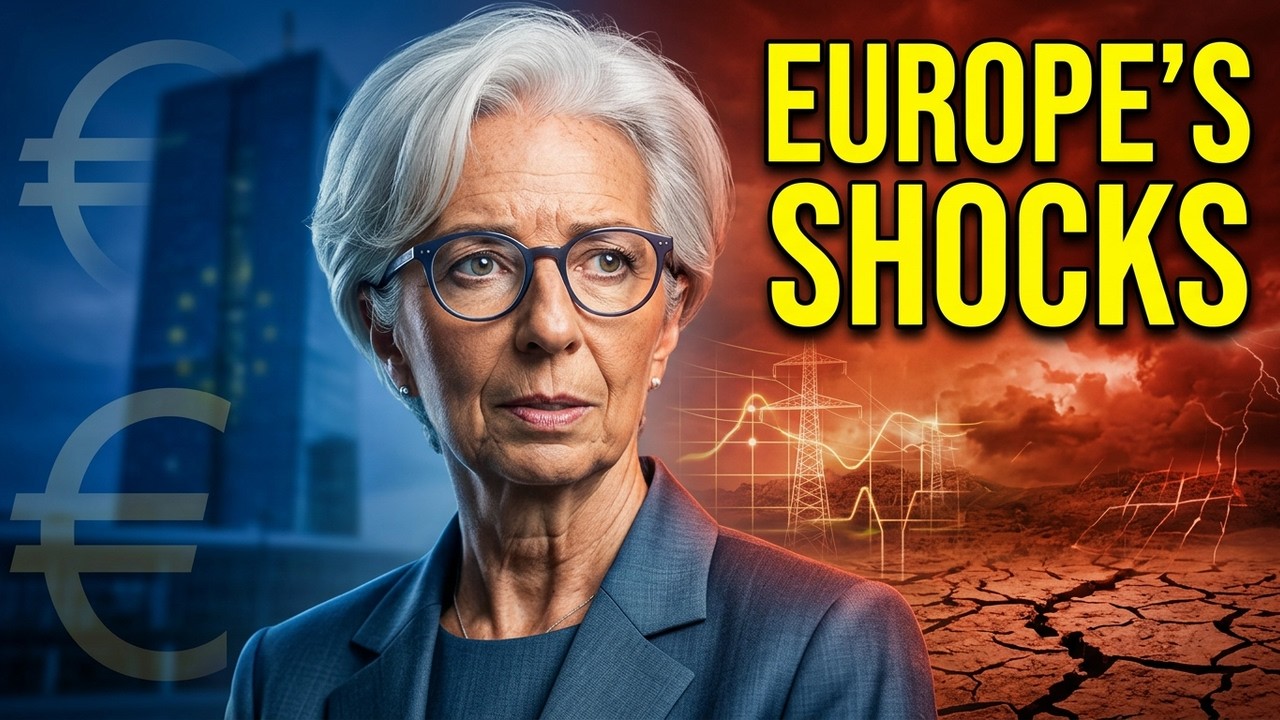
Christine Lagarde, President of the European Central Bank (ECB), warned at the ECB Forum on Central Banking in Sintra, Portugal, that Europe faces a “new era of geopolitical shocks.” Her opening speech highlighted the ECB’s return to policy rates as its primary tool for price stability, even as it navigates a more volatile global landscape shaped by supply shocks, geopolitical pressures, and energy risks.
Lagarde Warns of New Geopolitical Era
Opening the 13th ECB Forum, Ms. Lagarde addressed central bank governors, reflecting on the “extraordinary pressure” Europe has endured over the past 13 years. She cited challenges such as the sovereign debt crisis, the pandemic, fragmentation risks, Russia cutting off natural gas supplies, and the fastest tightening cycle in ECB history. Despite these past pressures, Lagarde emphasized that Europe has built greater resilience through various instruments, including ECB tools, banking supervision, resolution frameworks, and fiscal tools like Next Generation EU.
ECB’s Monetary Policy Shift
Lagarde stated that ECB monetary policy has “gone back to basics,” allowing the central bank to primarily focus on policy rates to stabilize inflation. However, she clarified that “a return to basics does not mean a return to the same idealized past.” Decisions are now “data dependent and taken meeting by meeting,” moving away from traditional forward guidance. The ECB’s rate decisions are guided by three criteria: the inflation outlook, underlying inflation dynamics, and the strength of monetary policy transmission.
Weaponized Resources and Volatility
The ECB President cautioned that the world has fundamentally changed, pointing to a “charged geopolitical environment” where market access, energy supplies, and critical minerals are increasingly “weaponized.” In response to this heightened uncertainty, the ECB is adapting by relying more on real-time indicators, improved projections, scenario analysis, and what she termed “framework guidance” instead of rigid forward guidance. She noted that “Forward guidance is not in the cards, nor is certainty for that matter.”
What was Christine Lagarde’s main message at the ECB Forum?
Christine Lagarde’s main message was that while the ECB is returning to conventional monetary policy tools like interest rates, Europe must prepare for a “new era of geopolitical shocks” in a more volatile global environment.
How has the ECB’s approach to monetary policy changed?
The ECB is shifting away from unconventional tools, now primarily using policy rates to manage inflation. Decisions are data-dependent and made meeting by meeting, replacing traditional forward guidance with “framework guidance.”
What new challenges does Europe face, according to Lagarde?
Lagarde warned of a “charged geopolitical environment” where market access, energy supplies, and critical minerals are increasingly “weaponized,” leading to supply shocks and heightened uncertainty for Europe.
