
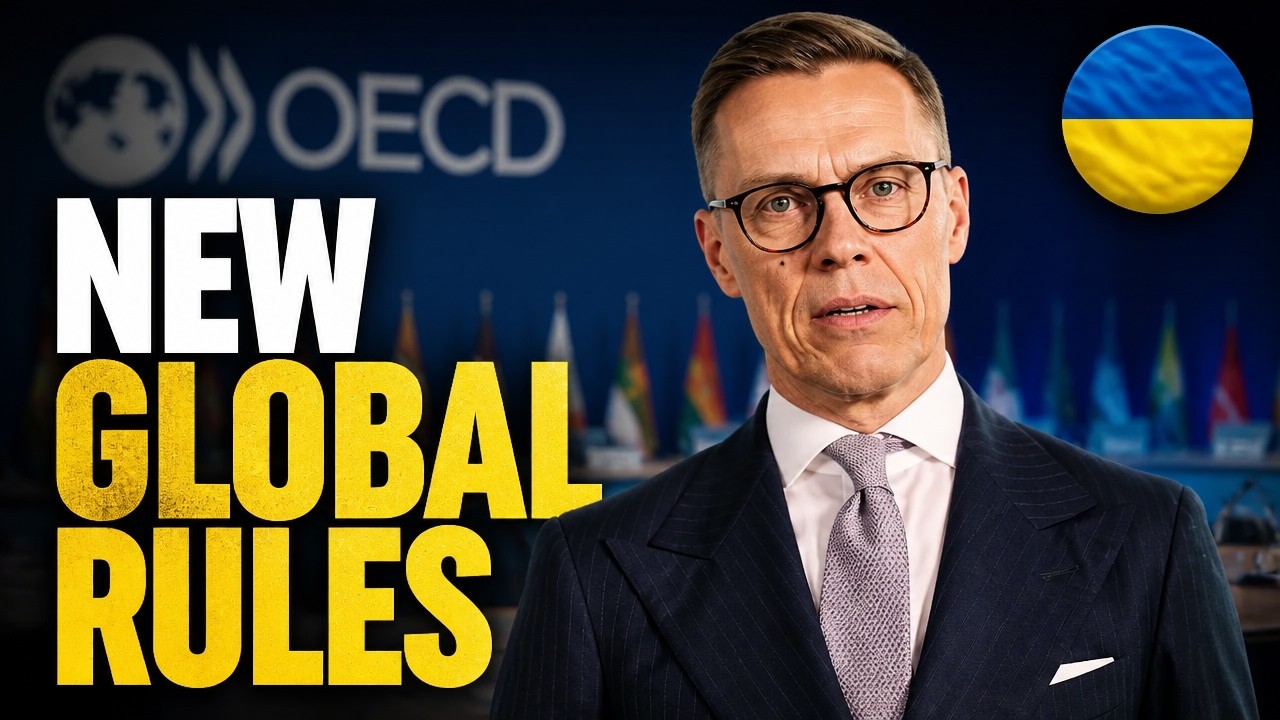
The 2026 OECD Shift: Stubb’s Plan for Ukraine, Trade, and Global Stability
Finnish President Alexander Stubb opened the 2026 OECD Ministerial Council Meeting in Paris with a powerful message on global economic leadership. As Finland chairs this year’s pivotal meeting under the theme “Getting Industrial Policies Right for Open Markets, Growth and Prosperity,” with Korea and New Zealand serving as Vice-Chairs, the stage was set for crucial discussions. In a landscape marked by geopolitical uncertainty, intense industrial-policy competition, escalating economic-security concerns, and a concerning rise in trade restrictions, Stubb championed the OECD as a vital, trusted platform for evidence-based cooperation and robust rules-based global governance.
Bridging Divides: The Global South at the Heart of Governance
A central tenet of Stubb’s address underscored the urgent need to connect like-minded democracies with a broader global audience. While reaffirming the OECD’s foundational values—democracy, human rights, rule of law, and market economics—he issued a stark warning: the organization’s global influence hinges critically on its outreach beyond its traditional membership. His most resonant declaration left no room for ambiguity: “There can be no meaningful global governance without the emerging Global South.” This statement firmly positions the Global South as indispensable to the future of economic diplomacy, industrial strategy, and international policy coordination, emphasizing a more inclusive approach to global challenges.
Defending Open Trade in a Fragmented World
President Stubb also voiced strong concerns over the proliferating spread of export restrictions and increasing trade friction. He passionately advocated for open, rules-based trade, branding it as an essential foundation for sustained global prosperity. He articulated that robust trade mechanisms and efficient markets are not only engines for economic growth but also crucial for diversifying value chains, thereby building resilience in an increasingly unstable world. His vision rejects protectionism, promoting instead a global economic environment where fair competition and predictable rules facilitate widespread benefit.
Prosperity and Peace: Ukraine’s Path to the OECD
In a compelling final section, Stubb drew a direct link between economic prosperity and the imperative of international peace and security. He lauded the OECD’s instrumental role in actively supporting Ukraine’s ongoing reform process and its future reconstruction efforts, signaling a profound commitment to the nation’s recovery and integration. He closed his address with a significant and forward-looking declaration: Ukraine should one day sit as a full member around the OECD table. This bold endorsement positions Ukraine’s eventual OECD membership as a testament to its commitment to democratic values, market economics, and a rules-based international order, reinforcing stability across the European continent and beyond.
Stubb’s Four Strategic Pillars for a Resilient OECD
President Stubb’s vision for the OECD in 2026 and beyond is clearly articulated through four strategic pillars, designed to guide the organization’s efforts towards a more stable, inclusive, and prosperous global future:
- Values-Based Community: The OECD must remain unequivocally anchored in the core principles of democracy, human rights, rule of law, and market economy.
- Outreach to the Global South: For truly meaningful global governance, OECD solutions and initiatives must extend their reach far beyond existing member states to actively engage the emerging Global South.
- Back to Basics on Open Trade: The fundamental principles of open, rules-based trade must be vigorously defended against the rising tide of export restrictions, trade friction, and the fragmentation of global value chains.
- Economic Prosperity & Peace: Acknowledging the intrinsic connection, growth, comprehensive reform, Ukraine’s crucial reconstruction, adherence to international law, and global security are all interwoven elements of a stable future.
President Stubb’s address at the OECD Ministerial Council Meeting 2026 has set a clear agenda for the organization, emphasizing cooperation, inclusivity, and a renewed commitment to the principles that underpin global stability and economic advancement. His strategic plan aims to adapt the OECD to the complexities of the 21st century, ensuring its continued relevance as a beacon of evidence-based policy and multilateral dialogue.
